
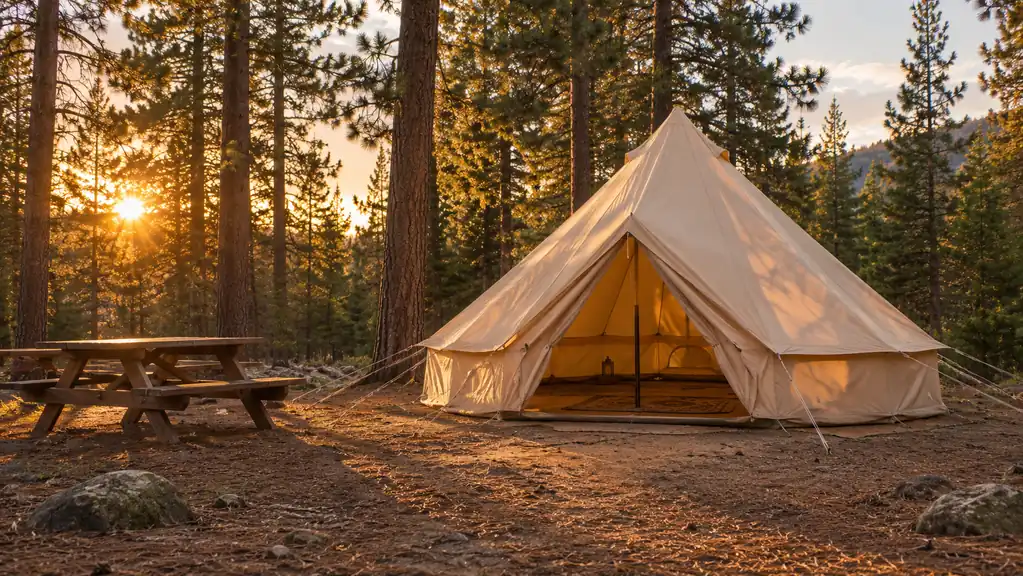
There is a version of this review where the WHITEDUCK Regatta is the perfect tent and you should order it before reading the rest. That version writes itself. It is also not true. I have slept in this tent at Shaver Lake, at Huntington Lake, and once on a Central Coast state beach where the wind came off the water all night and I got maybe three hours of sleep. I know where it earns its keep. I also know the two places it made me swear at it in the dark. If you are about to put money into a canvas bell tent, you should hear both halves.
I am 61, a retired utility lineman with a stiff lower back and one bad knee, and that shapes every gear opinion I have. A tent that pitches fast but makes me crawl on gravel is worse for me than a tent that takes longer and lets me stand up. Carol comes on most trips. On summer trips the grandkids come too, which means the tent has to survive children and stay dry doing it. My list of what matters is probably not a twenty-something's list, and I am not going to pretend otherwise.
The Quick Verdict
A well built canvas tent with walls tall enough to sit up against and a floor big enough for a family. Heavy, slow to pitch the first time, and it will fog up inside if you close the vents. Two seasons in and nothing in my family has been wet.
Amazon Check Today's Price →The Tent I Keep Loading Into the Truck
The Regatta, the size I run, and the flame-retardant version are all on the same listing. Current price moves with the season, so check it before you commit.
Amazon Check Today's Price on Amazon →How I've Actually Used It
Six trips across two summers and one cold shoulder season. Three were two-nighters with Carol, one was a four-night stretch with the grandkids, and two were solo trips where I wanted weather rather than a driveway test. The questions I asked were simple. Did I get wet. Did anything break. Did my back forgive me the next morning. The answers were no, no, and mostly.
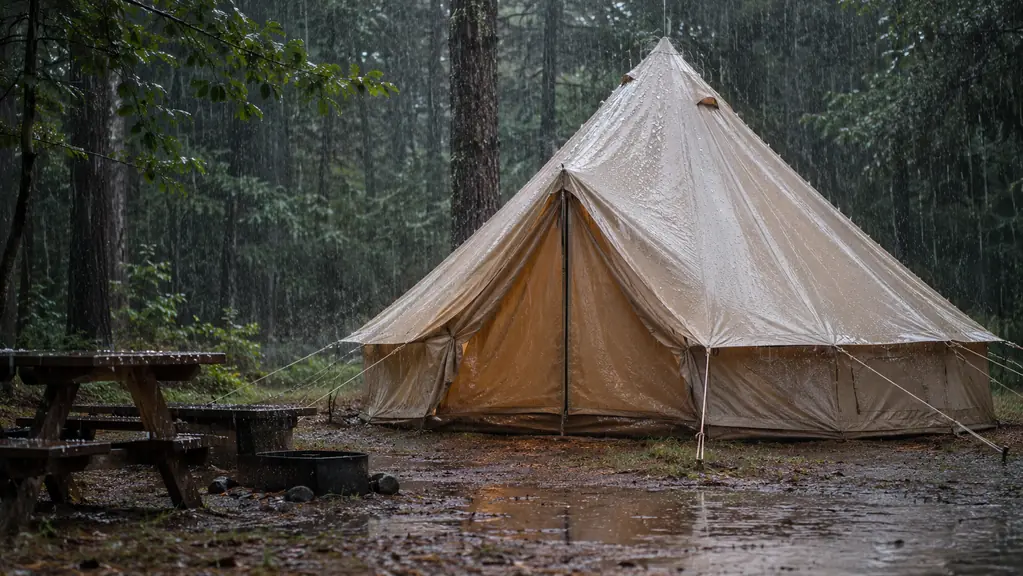
The first pitch was in my driveway on a warm afternoon, which tells you exactly nothing. The second trip it rained for an hour after dark. The third trip the wind came down the lake basin around two in the morning and I lay there listening to canvas move and wondering whether the poles would hold. They held. The whole tent breathed with the gusts, which is unnerving the first time and reassuring by the fifth.
The beach trip taught me the most. Central Coast fog, wind off the water all night, sand in everything. The tent held its shape and stayed dry inside. What I did not expect was how much the canvas cut the wind noise. In a dome tent that kind of wind flaps all night and you give up on sleep. Here it was a low steady rumble and I got a few hours. That trip is why I stopped thinking of this as fair weather only.
I have run a small wood stove in it twice, both times in cold weather. The stove jack is included rather than added later, and it did what it is supposed to do. The tent warmed up faster than I expected for something with walls this thin, and the jack did its job without any drama. I still would not leave a stove going while I sleep. That is my rule, not the tent's.
What Holds Up Better Than I Expected
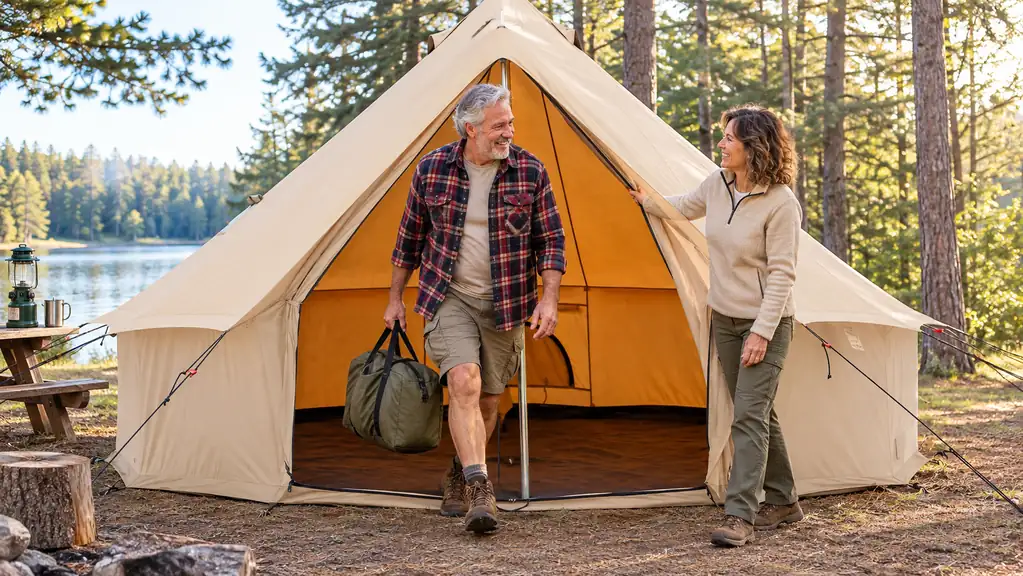
The waterproofing has held. WHITEDUCK treats the canvas with a PFC-free water repellent finish, and after three Sierra campgrounds and one foggy beach trip where everything else I owned got damp, I have not had water come through the roof or the walls. What I have had is condensation, which is a different animal and I will get to it in a minute. Confusing the two is the most common mistake I see in reviews.
The sewn-in groundsheet is the other thing I underestimated. Nothing shifts underfoot. Nothing bunches up in the corners when I sweep it out. Sleeping pads stay where I put them. I have owned tents where the floor felt like a plastic bag and tents with no floor at all, and a floor that is attached and canvas-weight is worth the packing bulk to me now.
Two doors matter more than the spec sheet suggests. With one door and kids going in and out, seven in the morning is a traffic jam. With two, the grandkids spill out one side and Carol and I get to the coffee without stepping over anybody. It is a small thing that turns into a big thing on day three of a trip.
The accessory pockets are more useful than I gave them credit for. Glasses, headlamp, keys, the small stuff that otherwise ends up in a pile by the door and gets stepped on. And the UV protection matters at altitude. Camp above 7,000 feet in the Sierra and the sun chews through nylon in a couple of seasons. Canvas with a UV treatment is the reason I expect this tent to still be around in five years when the dome tent I bought the same summer is not.
Three Sierra campgrounds, one foggy beach, two seasons, and not one drop has come through the roof or the walls. The wet I have dealt with was on the inside, and it was my own fault.
The Wall Height Is the Whole Ballgame
Standard wall height is 2 feet 7 inches, which is higher than a lot of bell tents. That number reads as boring on a listing until you have spent a night in a bell tent where the canvas slopes from the floor up. Then it is the most important number on the page. It means that at the edge of the tent, where the sleeping pads actually go, you have vertical canvas before the roof starts leaning in.
Practically, Carol and I can sit up on the pads and reach for a mug without folding ourselves in half. I can get dressed standing at the center and sitting at the edge. With my back, the difference between getting up off a pad by myself and needing a hand from somebody is about six inches of canvas, and that six inches is here. The doors are cut to match, so I come through upright for most of my height rather than on my knees.
What Nobody Tells You About Canvas
Canvas breathes. That is why four people can sleep in this thing and not wake up in a swamp. It is also why the inside can feel damp to the touch on a cold morning when nothing has leaked at all. Three mesh windows and the roof vents are how you manage it. Open them. Every night. Even when it is cold, even when it is drizzling, especially when there are four of you breathing in there.
The first cold night I closed everything because I was chilly. I woke up to a ceiling that was wet to the touch and a sleeping bag that felt clammy, and I spent twenty minutes convinced the tent leaked. The second night I left the vents and one window cracked and I woke up dry. That is the whole lesson, and it cost me one bad night to learn.
Canvas also holds a campfire. Permanently. That is charming for about a month and then it is just your tent. And it is heavy. 60.6 pounds dry, and noticeably heavier wet. If you have ever hauled wet canvas out of a truck bed you already know what I mean. Plan on a dry-out session at home before it goes into storage, or you will own a tent that smells like something crawled in and stayed.
The Setup, Honestly
This is not a fifteen minute tent, whatever you have read. I get it up in about twenty five minutes alone now. The first time took me close to an hour because I had the door facing the wrong way and I was guessing at the pole order. With Carol holding the center pole while I stake, it is closer to fifteen. That is the honest number for two reasonably fit adults.
The sequence that works: lay it out, find the door, stake the four corners, raise the center pole, then work the rest of the perimeter. Get the corners right and it stands up on its own, which is what free standing means in practice. Get the corners wrong and you fight canvas for twenty minutes. I have done both, more than once.
The tool kit that comes with it is fine. It is not what I would buy separately, and I swapped to longer stakes because Sierra soil is full of granite and short stakes bend. That is not a knock on the tent, it is a knock on the ground up there. Factor in ten minutes of staking either way, because a canvas tent that is not staked properly is a sail.
Taking it down is the easy half and it is still twenty minutes. Folding canvas so it goes back in the bag is a skill. My first three attempts looked like I was wrestling a body bag. Now I fold it in thirds, walk the air out of it, and it goes in without a fight. If it is wet when you take it down, it comes out of the bag the moment you get home, goes up in the yard, and stays there until it is dry. Every time. No exceptions.
Sizes, the Stove Jack, and Which Version to Get
It is listed as a six person and 132.67 square feet is honest math for that. Six adults in sleeping bags fit. Six adults with duffels and coolers do not, and nobody camps that way anyway. My real number is two adults plus two grandkids with room left over, or four adults on pads without anybody touching. If you need standing room for a crowd, go up a size. If you are two people, the six person is more tent than you need and you will feel it every time you set it up.
On the stove jack: it is included, not an add-on, and it is the reason this tent covers a fourth season and not just a third. If you camp in the Sierra in October, that matters. If you only camp in July, you will never use it and it will not bother you. There is also a flame-retardant version on the listing. If you plan to put any kind of heat inside a canvas tent, read that part carefully before you order and match what you buy to what you plan to burn.
What I Don't Like
The weight. 60.6 pounds is fine from the truck bed to a site twenty feet away. It is not fine for a walk-in site where you are carrying gear half a mile. I did that once and I will not do it again. This is a car camping tent and WHITEDUCK built it like one, which is the right call for who this is actually for and the wrong call if you had backpacking ambitions.
Wind turns setup into a two person job. One person can manage in calm air. Add a real gust and you need somebody on the canvas while somebody else gets the center pole up, or it folds over on you. Carol and I have done that dance and we both had opinions about it.
Condensation if you close it up, which I covered above and will repeat because it is the complaint that makes people think the tent leaks when it does not. And the packing bulk is real. With the tent, the poles, the stove, a cooler and two camp chairs, the Tacoma bed under the shell is full. Measure your trunk before you order if you drive something smaller.
The zippers have been fine, which I did not expect. Canvas zippers are their own animal and they stiffen up in cold weather. Mine have run clean, but I keep them clear of sand and I do not force them. Force a canvas zipper and you are looking at a repair job, not a campground fix.
What I Liked
- PFC-free water repellent canvas that has not let rain through in two seasons
- 2 foot 7 inch walls mean you can sit up at the edge of the floor, not just the middle
- Two doors cut the morning traffic jam when kids are coming and going
- Sewn-in groundsheet does not shift or bunch up at the corners
- Stove jack included, so cold weather camping is on the table without a second tent
- 132.67 square feet of floor, enough for six in sleeping bags without stacking them
Where It Falls Short
- 60.6 pounds dry, and heavier wet. Not a tent you carry anywhere
- About 25 minutes to pitch solo, and closer to an hour the first time
- Ceiling goes wet with condensation if you close the vents overnight
- Needs a dry-out session in the yard before storage, every time
- Windy days make setup a two person job, no way around it
Who This Is For
This is for the family that drives to a campground and stays put for a few nights. Two adults and a couple of kids fit in 132.67 square feet with room to stand up and get dressed. It is for the camper with a bad back or bad knees who is tired of crawling in and out of a dome tent, and the 2 foot 7 inch walls plus the two doors are the reason. It is also for the shoulder season camper who wants a stove jack without buying a second tent. If any of that sounds like your trips, this is a sensible buy.
Who Should Skip It
Skip it if you hike in. Skip it if you camp out of a sedan. Skip it if you want to be set up ten minutes after a long drive, because you will not be, not the first five times. Skip it if you are not going to dry it out at home and you care how your gear smells. And skip it if you only camp in fair weather in July and August, because a modern dome tent does that job with a lot less effort.
Two Seasons In and I'd Buy It Again
It is heavy, it is slow, and I still load it every trip. Check the current price and the size options on the listing, and read the flame-retardant note if you camp in cold weather.
Amazon Check Today's Price on Amazon →