
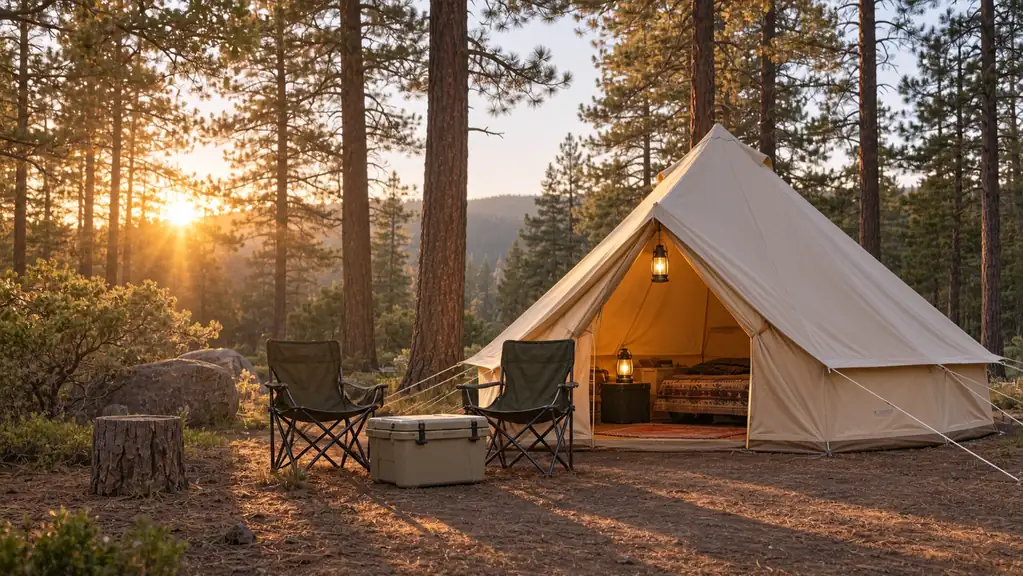
I have stood in the dark at Shaver Lake holding a ridge pole while my wife Carol aimed a headlamp at a set of instructions, and I have pitched a bell tent alone in about the time it takes the coffee to finish. Both tents kept the rain out. Only one of them left my lower back complaining for two days, and it was not the bell tent. I am sixty-one, I spent thirty years climbing poles for a living, and I have stopped pretending that a tent I cannot put up by myself is a tent I will actually use.
Here is the short answer. The WHITEDUCK Regatta Canvas Bell Tent is the better buy for weekend car camping, for a couple, and for a family with grandkids running in and out of the door. It is free standing, one person can raise it, the stove jack is already sewn in, and there is no frame to assemble in the dark. A canvas wall tent still wins for a hunting camp or a base camp that sits in one spot for two weeks in real cold. The rest of this is why.
| WHITEDUCK Regatta Bell Tent | Canvas Wall Tent | |
|---|---|---|
| Setup, one person | Free standing, goes up with the poles in the bag, roughly twenty minutes once you know it | Frame assembled inside the canvas, realistically a two person job, closer to an hour |
| Packed weight | 60.6 pounds for the complete package | Heavier once the frame and stakes are counted, usually a two person load |
| Floor area | 132.67 square feet, round, six person rating | Rectangular and it scales up, you can buy one big enough for a bunk setup |
| Headroom at the walls | Wall height of 2 feet 7 inches, then the roof slopes in | Near vertical walls, so you can stand close to the edge |
| Stove jack | Sewn in and included with the tent | Often an add-on, sometimes a hole you cut and seal yourself |
| Doors and windows | 2 doors and 3 windows with mesh | Usually one door, windows vary by maker |
| Wind | Round walls shed gusts, the tent shrugs and stays put | Flat end walls catch wind and need solid guying |
| Snow load | Sheds rain well, but you will be knocking snow off in a real storm | Steep ridge roof carries a snow load the way a roof should |
| Long stays | Fine for a weekend, tight by day eight | Built to sit in one spot for weeks |
| Best for | Weekend family camping and short walk-in sites | Hunting camp and long cold weather base camps |
Setup, Weather and Space: What Actually Decides It
Setup is the first thing, and it is where these two part company. The Regatta is free standing. It stands up on its own before you have driven a stake, which means you can look at it, decide you are on a root, and walk it two feet to the left. It goes up with the poles that come in the box, one person, and it comes down the same way. A canvas wall tent of the same footprint needs its frame assembled inside the canvas, and even the makers who advertise a one person pitch are usually counting on a calm evening and a second set of hands. Call it twenty minutes against an hour. Over a season, that is the difference between a tent you use and a tent you dread.
The second thing is weather. WHITEDUCK treats the Regatta canvas with a PFC-free water resistance treatment, so it sheds rain without the fluoro chemicals, and it carries UV protection, which matters at 7,000 feet where the sun will eat an untreated tent in three summers. There are roof vents to let the warm damp air out, mesh in the windows, and a sewn-in groundsheet. That last one is worth more than it sounds. A sewn-in floor means no gap at the base for wind driven rain to find, and no separate tarp to chase around the campsite. The tent is listed as three season and four season, and there is a flame retardant version if you plan to run a stove hard.
I learned the value of that sewn-in floor the hard way back in 2019, on a June weekend at Huntington Lake when a thunderstorm came over the ridge at four in the afternoon and sat on us for three hours. The old tent I had then used a separate ground tarp, and by the second hour the wind had worked one corner of that tarp out from under the wall entirely. Water came in along six inches of the back edge and soaked the foot of Carol's sleeping pad. The Regatta does not have that failure in it. There is nothing to work loose, because the groundsheet is stitched to the wall.
The third thing is space, and here the numbers are honest but easy to misread. The floor area is 132.67 square feet with a six person rating. Read any tent rating the way it deserves to be read: six people is six people lying down like pencils with nothing else inside. In practice the Regatta is a comfortable four adults on cots with duffels, or two adults and two grandkids with room left over for a cooler and a card game. The wall height is 2 feet 7 inches, which is taller than most bell tents, but the roof is still a cone. You stand up in the middle. Near the walls you duck. That is the trade for a tent that sheds wind and water the way a round shape does.
Where the WHITEDUCK Regatta Bell Tent Wins
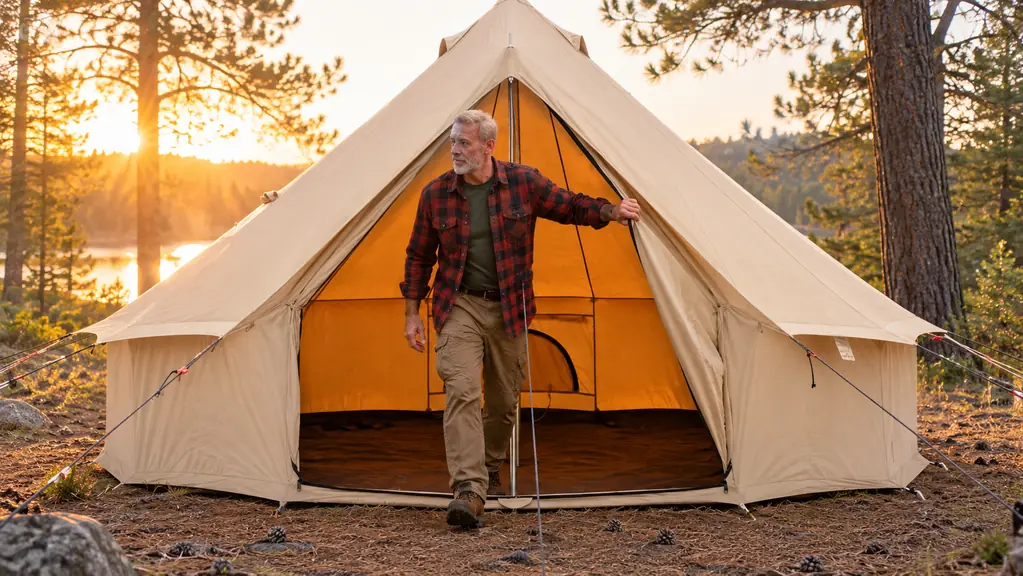
It wins on what it asks of your body. The door is a step through, not a crawl, and there are two of them, so the grandkids come in one side and out the other instead of climbing over your bedroll. The floor is sewn in, so there is no lip to trip on and no tarp edge to catch the wind. If your knees are like mine, you will notice that you can stand upright in the middle to pull your pants on, which sounds small until you have spent a week getting dressed lying down in a low tent.
It wins on what comes in the bag. The stove jack is sewn in and included, not an add-on you order separately or a hole you cut yourself and hope about. The package includes the groundsheet, the poles, a tool kit and the stove jack, along with mesh windows, roof vents and accessory pockets for glasses and a headlamp. A zipper closure on the doors and windows is a small thing that stops being small in a blow, when a flap that ties instead of zips starts slapping all night. Count the pieces against a wall tent order and the difference is real: a wall tent frame alone can be six or eight separate rails that all have to be matched to their sockets, and the first time you do it in the dark, you will get one wrong.
And it wins at the end of the trip. The whole package is 60.6 pounds. That is not a backpacking weight, and it is not meant to be. It is two trips from the Tacoma to the site, or one trip with a hand truck, and it slides into the bed under the camper shell next to the cooler. Sunday morning takes twenty minutes instead of an hour, and that is the reason a weekend trip actually feels like a weekend. Last September I timed it out of curiosity, from the moment I started pulling stakes to the moment the bag was zipped in the truck bed: nineteen minutes, and that included a stop to shake pine needles off the groundsheet.
Sixty pounds in the bag, one person, no frame to assemble, and the stove jack already sewn into the roof.
Where a Canvas Wall Tent Wins
A wall tent wins on floor plan. It is a rectangle with near vertical walls, and a rectangle uses its corners. You can push two cots against one wall, set a table against another, put the stove in the middle and still walk between them without stepping over anybody. Round tents are generous in the middle and stingy at the edges, and the edges are where cots and duffels and wet boots actually live. If four people are sharing a tent for a week with gear, a wall tent of similar footprint simply lives better.
It wins in snow and in a long stay. A wall tent has a steep ridge roof that carries a snow load the way a roof is supposed to, and the ones I have helped pitch are built heavy on purpose, because they are meant to sit in one place for weeks and take weather that would have you packing up a lighter tent. If you are running a woodstove every night in November at 8,000 feet, you want the tent that was designed around that stove, with walls that do not lean in on your cot when the wind gets under the fly. The first week of November is when a bell tent's cone starts to feel like a funnel and a wall tent's ridge starts to feel like a roof.
It also wins when the tent is not really yours to carry. A wall tent on private ground with a deck or a platform under it, or a hunting camp where somebody else hauls the frame in a truck and the same crew comes back every fall, is not a camping tent at all. It is a cabin made of canvas, and it is the right answer for that job. It is just the wrong answer for a Friday night arrival at a Forest Service campground with one person doing the work.
One person, twenty minutes, and the stove jack already in the roof
The WHITEDUCK Regatta ships with the sewn-in groundsheet, stove jack, mesh windows, roof vents, poles and a tool kit. Check the available sizes and the flame retardant version on the listing.
Amazon Check Today's Price on Amazon →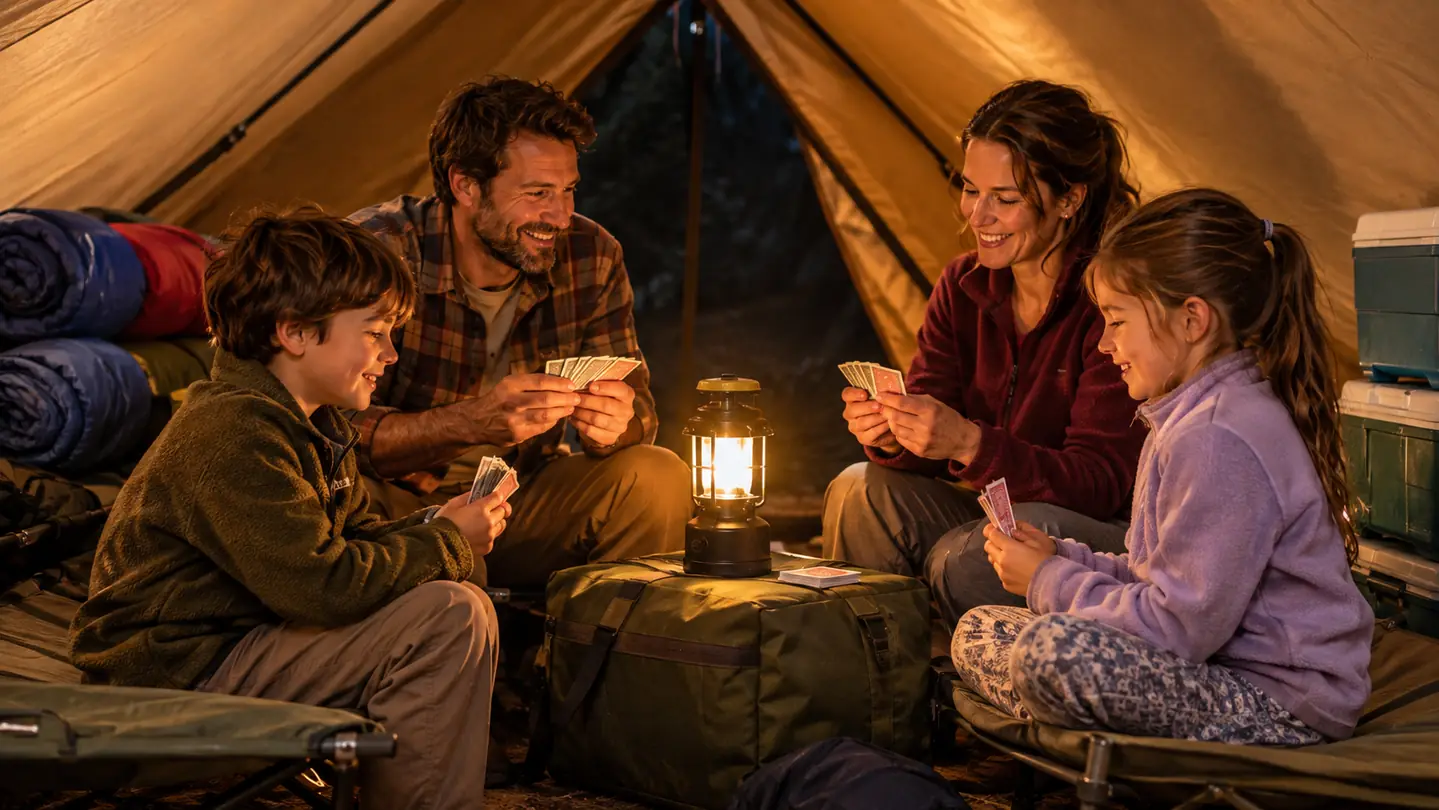
The Cold Weather Question
People ask whether a canvas bell tent is a four season tent, and the honest answer is that it depends on what you mean by four season. The Regatta is listed as three season and four season, and it has a stove jack, so with a stove and a liner and a decent sleeping bag you can be comfortable well past the first frost. What it does not have is an insulated wall, and neither does a wall tent. What it does have is roof vents, and vents are what keep the inside of a canvas tent from raining on you from condensation when the stove is going and it is twenty degrees outside.
The flame retardant version is worth a look if you plan to run a stove hot and often. Canvas that has been treated to resist flame is the version I would pick for regular winter use, and it costs more than the standard one, which is one of the few places I would tell you to spend up. The stove jack is sewn in either way, so you are not cutting a hole in a new tent and sealing it yourself with a tube of silicone and hope.
Where the wall tent still has the edge in cold is volume and roof pitch. A steep roof sheds snow instead of pooling it, and a taller wall line gives the stove more air to work with and gives you more room to stand back from it. If your winter camping means a two week camp with the same stove burning every night, the wall tent is the more comfortable room. If it means a weekend in October with frost on the picnic table, the bell tent gets you warm faster because it is smaller and it goes up in the light.
One more practical note on cold, and it is about the ground. A sewn-in groundsheet keeps the wind off your back from underneath, which in a wall tent often means laying your own floor over a spike of cold air coming through the gap at the base of the wall. I have done both. The difference on a thirty degree night is not subtle. You notice it in your shoulders, and you notice it around four in the morning when the stove has burned down and the canvas has gone slack.
Who Should Buy Which
Buy the WHITEDUCK Regatta if you camp out of a vehicle, if you are the one doing the pitching, if you want to stand up to get dressed, and if a stove jack that is already sewn in saves you a chore you were not looking forward to. It suits couples, small families, and anybody whose back has already voted on the matter. It is the tent I would hand to a first time camper over sixty, because it does not ask them to kneel in the dirt and thread a frame together in the dark.
Buy the wall tent if your tent does not move once it is up, if you have help and a truck to haul the frame, if you camp in snow, or if you are setting up a hunting camp that stays for two weeks. It is a better room and a worse errand. Be honest with yourself about which of those you are actually signing up for, because the best tent in the catalog is the one still sitting in the truck because you did not want to pitch it.
The tent that goes up while the coffee is still hot
Free standing, sewn in groundsheet, stove jack included, 132.67 square feet and 60.6 pounds in the bag. Check today's price and the current size options on the listing.
Amazon Check Today's Price on Amazon →