
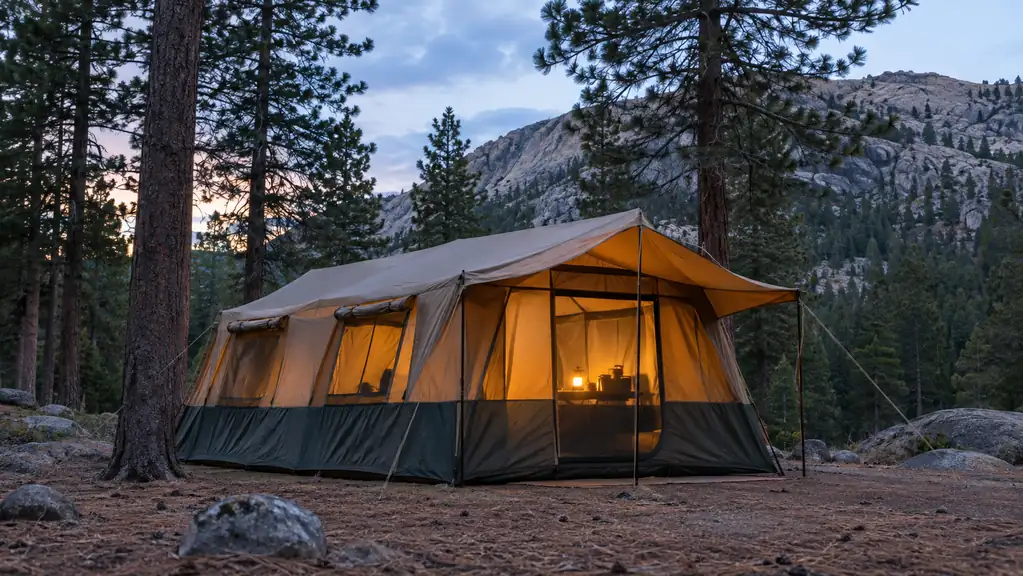
The first time I pitched the CORE Instant Cabin, I did it in the dark. Carol and I rolled into Shaver Lake well after the sun dropped behind the ridge and the campground host had already gone home. I set my flashlight on the tailgate of the Tacoma, unzipped the bag, and had the thing standing in about the time it takes to boil water for coffee. Forty years of Sierra trips and I had never had a tent go up that easily with my glasses fogged and one knee complaining.
That is the short version of this review. The CORE Instant Cabin is a 14 by 9 foot cabin tent with 78 inches of center height and 126 square feet of floor, and the reason I have kept it through three seasons is not the floor space. It is that a 61 year old man with a stiff lower back can set it up alone and take it down alone, in the cold, without the kneeling and cussing that used to be part of the deal.
The Quick Verdict
Goes up in minutes and stays dry through a real Sierra storm. Buy it for the setup and the standing height, plan around the packed weight.
Amazon Check Today's Price →Pitch it once and you will not want to fight a pole sleeve again
Current price and more than 7,000 owner reviews are on the Amazon listing. Worth reading a few from tall campers before you commit.
Amazon Check Today's Price on Amazon →How I've Used It
I have put this tent up and taken it down on roughly 26 nights over three seasons. Three trips to Shaver Lake, one to Huntington Lake, one in the Sequoia area near Lodgepole, and one long weekend at a Central Coast state beach with the grandkids along. It has been through a two hour thunderstorm with sideways rain at Huntington, a night of steady wind at Shaver that flattened a neighbor's dome tent, and four or five damp mornings where everything I owned smelled like pine and wet nylon.
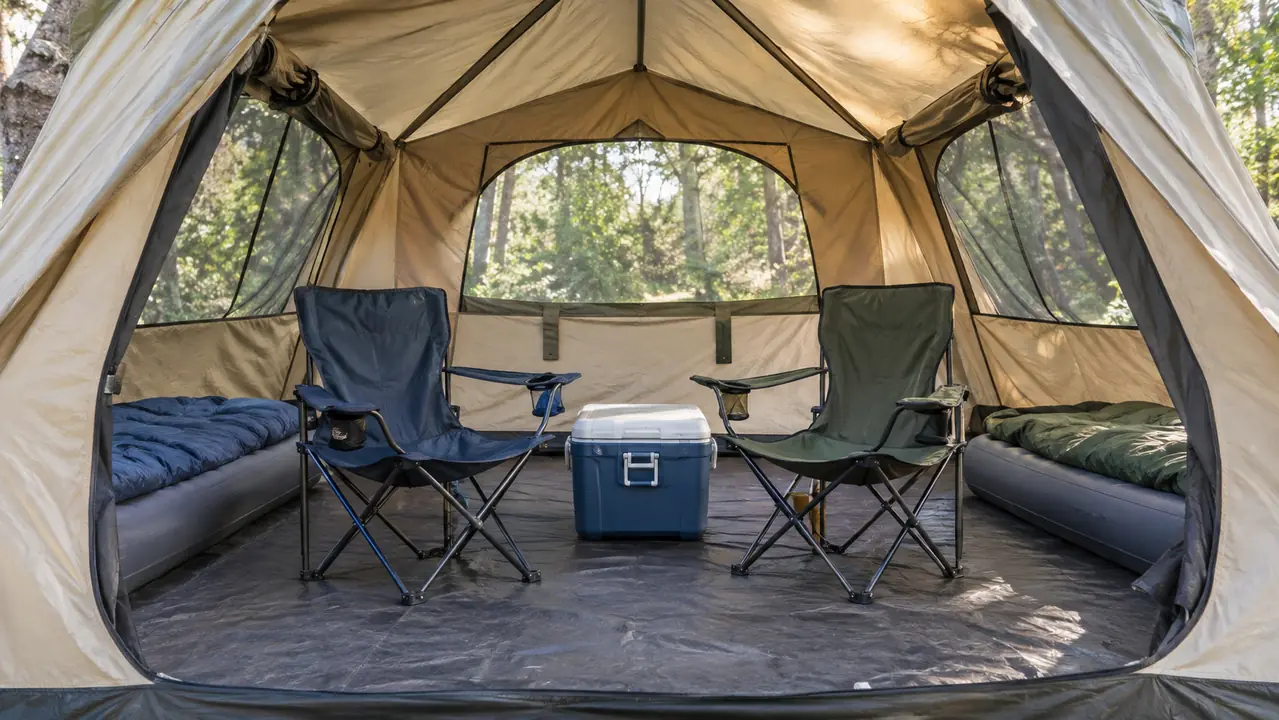
Inside, we run two queen air beds, one at each end, and a pair of folding chairs in the middle room. That leaves a walkway down the center and enough floor for duffels and a cooler. The listing says it sleeps nine. Nine is a number somebody arrived at with a tape measure and no gear. Four adults with cots and bags is comfortable. Six is tight but workable if it is family and nobody needs personal space.
The Sequoia trip is the one I judge it by. We pulled into a walk-in site near Lodgepole around dusk and the pad was not level, maybe six inches of fall from the high corner down to the low one. A freestanding frame does not care much about that. I set the four corners, lifted the low side, and walked the whole tent a foot uphill until the beds sat close to even. Try that with a tent that has to be staked drum tight before it holds any shape and you will be out there in the dark pulling stakes and starting over.
What matters to me now is the 78 inch center height. I can stand up to change clothes and to pull on my boots, which sounds like a small thing until you have spent a week hunched over in a dome tent. The doors are wide enough that I am not crawling out on hands and knees first thing in the morning, which my knee appreciates more every year. Setup height and door size are the two specs I would tell any older camper to check before anything else.
Setup: What the Two-Minute Claim Actually Means
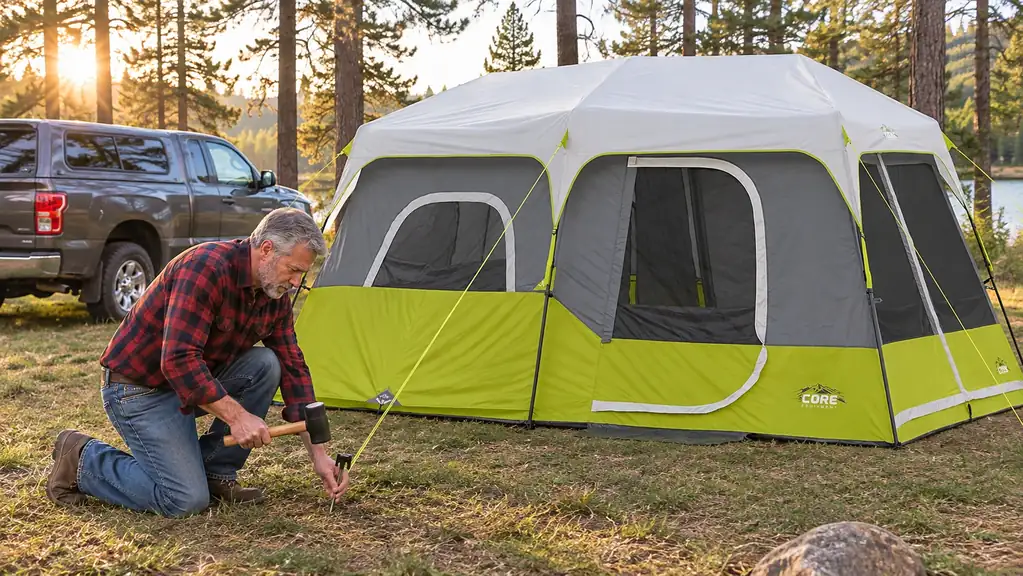
The poles come attached to the tent body. You pull the bundle out, shake it, and the legs drop into place, then you push each one until it locks. There is no fishing a shock corded pole through a sleeve, no guessing which pole goes where, no diagram taped inside the bag. The first time took me a little over three minutes by myself in the dark. Daylight, no wind, third season, I can do it in about two and a half with the stakes in.
The two minutes in the listing is the frame going up. The rest of the job is the guylines and the steel stakes, and that is where the time goes. On a calm night I skip most of the guylines. If weather is coming, I set all of them, and then the clock runs closer to ten minutes from truck to finished. That is still quick. I would rather give you a real number than a marketing one.
The worst conditions I have set it up in were at Shaver in October, with a gusty crosswind coming off the lake. Carol held the downwind corner while I pushed the legs up. Even with the frame half raised and moving around, nothing bent and nothing popped loose. That is the real advantage of pre-attached poles. There is no separate pole bundle to lose, and no sleeve to feed while the wind takes the fabric and turns it into a sail. Two people do it in well under two minutes in that wind. One person alone takes about five and a certain amount of language I will not put in print.
Taking it down is the same in reverse, and it is where I watch people struggle. You have to get the air out. I unzip both doors, pull the rainfly off, and let the tent sit for five minutes while I load the chairs. Then I fold the panels in toward the center and press, rather than rolling, which pushes the trapped air out the doors. Folded that way it goes back in the bag without a wrestling match.
Rain, Wind, and What the 1200mm Fabric Means
The fabric is rated at 1200mm and CORE calls the system H20 Block, with a fully taped rainfly, sealed seams and windows that zip fully shut. That combination matters more than any single number. A taped fly over sealed seams means water is not finding a stitch hole to wick through, and stitch holes are how most tents get wet. It is rarely the fabric itself.
At Huntington Lake we took a storm that came in fast off the ridge. Rain hit sideways for close to two hours and the wind pushed the west wall in a few inches. I sat inside with one hand on the wall and waited it out. When it stopped, the floor was dry, the bedding was dry, and the only water inside was what I tracked in on my boots. I have owned tents that failed that exact test and I got rid of them.
The morning after that storm I walked the perimeter before breakfast. Every guyline was still taut, none of the stakes had pulled, and the underside of the rainfly was dry. Water had run off the fly and pooled at the low corner of the site, which is exactly what you want. The water goes around the tent instead of through it. I did find one thing worth knowing. The fly had stretched slightly where it stayed wet overnight, so I re-tensioned the two windward lines before we broke camp. That took about ten seconds and it was drum tight again.
It is a three season tent and it does not pretend otherwise. In a hard sustained wind it moves, because a cabin this tall carries a lot of sail. I would not take it up high, I would not use it in snow, and I would not leave it standing empty in a serious blow without every guyline set. Know what it is for and it will not let you down.
Living in 126 Square Feet
The tent is divided into three rooms, and that is the feature I did not expect to care about. Carol goes to bed earlier than I do. With the divider closed she has her end, I have mine, and the middle room holds the chairs, the cooler and the boots. Two doors means nobody climbs over anybody at two in the morning, which at my age is worth more than an extra foot of floor.
The beach trip is where the three rooms earned their keep. Two grandkids in the middle section on pads, Carol at one end, me at the other. By nine o'clock the dividers were zipped and the adults had a light on at each end without waking anybody. The second door meant the kids could get out at night without walking through the room where Carol was already asleep. I did not think two doors mattered much when I bought it. After a summer with the grandkids I would not buy a family tent without them.
There are storage pockets sewn into the walls, and they hold the small things, glasses, phone, headlamp, so the floor stays clear. The full zip windows on both sides give real cross flow on a warm night. On a cold night you zip them and the tent holds heat noticeably better than a mesh dome. Condensation is the trade. I get a little on the inside of the fly on a cold, still night, and cracking one window an inch takes care of it.
What Has Worn After Three Seasons
The zippers have held. Both doors, three seasons, a lot of traffic with grandkids going in and out. No skipped teeth, no split coils. The four poles are still straight and still lock positively, and I cannot find a pinhole or a sun rotted patch in the fabric, though I store it dry and out of the light.
There is one more wear item I keep an eye on. The joint where each leg locks is the part that would end the tent if it failed, so I check all four every spring when I air it out in the yard and again before we leave on a trip. So far they lock the same as the day I bought it. They do pick up grit, and a rinse with the hose at the end of the season keeps them working smoothly.
What has worn is the cheap stuff. Two of the steel stakes bent in hard ground at Sequoia and I replaced them with heavier ones from the hardware store. The seam at the top of the carry bag has started to fray, because 27.6 pounds of tent going into a bag is a wrestle every single time. Neither of those is a reason to pass on it. They are simply the parts I expect to give first.
I set it up in the yard after every trip and let it dry all the way before it goes back in the bag. That one habit decides whether a tent lasts five years or two. Put it away damp and you will get mildew, and mildew does not come out of coated fabric.
Packing It Down and Into the Truck
Packed, it weighs 27.6 pounds, and that is a two handed carry for me, not a one handed one. It rides in the Tacoma bed under the camper shell with the chairs and the stove and still leaves room for the cooler. If you are loading a sedan or a small SUV, measure the space first. Fourteen feet is a real footprint on the ground and a real bundle in the bag.
Loading it into the truck is a two step job for me now. I lift the bag onto the tailgate, then slide it in along the shell floor rather than swinging it over the side. That sounds fussy until your back reminds you why. With the chairs, the stove, the cooler and two air beds aboard, the tent bag takes up maybe a third of the bed. There is still room for firewood and a water jug, which is all I need for a week.
It is not a backpacking tent and I would not carry it a mile. For car camping and short walk in sites where you make one trip, the weight is the price of the standing height and the room, and I will pay it. My back complains about the carry, not the setup. That is the trade, and it is the right one for how we camp.
What I Liked
- Pre-attached poles lock into place, so one person can raise the frame in a couple of minutes
- 78 inch center height lets you stand up to dress and pull on boots
- Stayed dry through two hours of sideways rain, with a taped fly and sealed seams
- Three rooms and two doors keep a family from climbing over each other at night
- Full zip windows on both sides, plus wall pockets that keep the floor clear
Where It Falls Short
- 27.6 pounds packed and bulky, a two handed carry to the site
- The two minute claim covers the frame only, not guylines and stakes
- A tall cabin shape catches wind, so it needs every line in weather
- The included steel stakes are thin and bend in hard ground
- The seam at the top of the carry bag started to fray in season three
We took two hours of sideways rain at Huntington Lake and the floor stayed dry. That is most of the review, honestly.
Who This Is For
Families who car camp and want one tent that goes up before the kids get restless. Older campers in particular, anyone with a back or a knee that has opinions about kneeling in the dirt, will notice the difference the first time they set this up alone. Hunters and fishermen who roll into camp late and want to be inside a dry tent in ten minutes will like it too.
It also suits anyone who has been through a pole tent that leaked at the seams. This one has a taped fly and sealed seams, and in my experience that is the difference between a wet sleeping bag at 3 a.m. and a normal night's sleep.
Who Should Skip It
Backpackers and anyone hiking in more than a quarter mile should pass. At 27.6 pounds packed, this is a truck tent in everything but name. If you camp in serious alpine wind or shoulder season snow, you want a lower, heavier framed tent instead. A cabin this tall simply catches too much air.
And if you drive a compact car with a full trunk, check the packed size before you buy. Fourteen by nine feet is generous on the ground and greedy in the cargo area. Measure, then decide.
If your back has opinions about tent poles, start here
Three seasons in and I still set it up alone, in the dark, at 61. Current price and owner reviews are on the listing.
Amazon Check Today's Price on Amazon →