
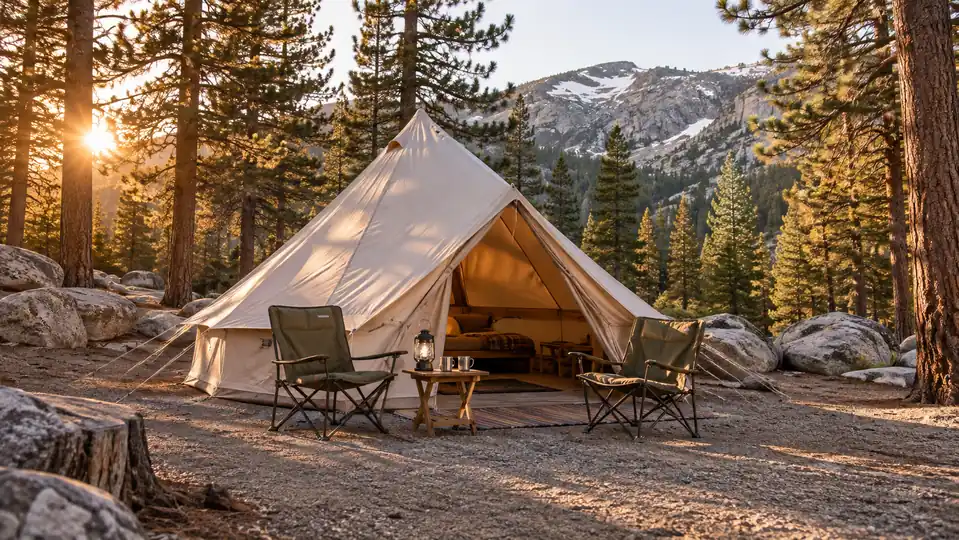
I bought a canvas bell tent figuring it would behave like the nylon dome it replaced, just heavier. It does not. The WHITEDUCK Regatta Bell Tent weighs 60.6 pounds and opens up to 132.67 square feet of floor, and the fabric that keeps it cool in July and quiet in a Sierra wind is the same fabric that will grow mildew in your garage if you fold it away damp. Canvas is not fragile. It is just unforgiving about the two or three moments when it needs your attention. Give it those moments and it will outlast every nylon tent you have owned.
I am 61, retired out of the utility trade, with a lower back that files a complaint every morning and a right knee that only bends so far. So nothing below involves hanging a tent from a rafter or wrestling 60 pounds of wet canvas across a driveway alone. Most of this work happens standing up at the campsite, before you drive home. The rest happens in the garage in about the time it takes to finish a cup of coffee.
A Tent Worth Twenty Minutes of Care
Canvas, a sewn-in groundsheet, two doors, three mesh windows, roof vents and a stove jack, with a 2'7" wall height and 132.67 square feet of floor for up to six people. Here is the care routine that keeps it in service for a decade.
Amazon Check Today's Price on Amazon →Step 1: Pitch It on Ground That Drains, With the Doors Facing the Weather
Pick your ground before you pick up the bag. Canvas is heavy enough that you want to unload it once, not twice. Look for ground that sheds water: pine duff over sand, gravel, or a flat granite slab with a slight tilt. Avoid the low spot at the edge of the meadow that looks so inviting at four in the afternoon. It is the same low spot that will have two inches of water in it at two in the morning. Then look up. A dead limb over your roofline is the only thing on this list that can actually hurt you.
Lay the tent out with the sewn-in groundsheet flat and stake the corners first, then raise the poles. The Regatta is free standing, which means once the poles are in you can walk it a few feet one way or the other if your first read on the ground was wrong. Do that before you stake the guy lines. I learned it the boring way at Huntington Lake, dragging a fully pitched tent three feet to get it off a root.
Face one door away from the prevailing wind and set the other toward your sitting and cooking area. The wall height matters more than it sounds. At 2'7" you can sit on a cot with your shoulders clear instead of hunched like you are twelve years old in a pup tent. Tension the guy lines until the walls stop flapping, but not until the fabric looks like a drum. Tight canvas in hot sun plus a hard wind is how you stretch out a seam.
Step 2: Clean the Canvas With Water and a Little Patience
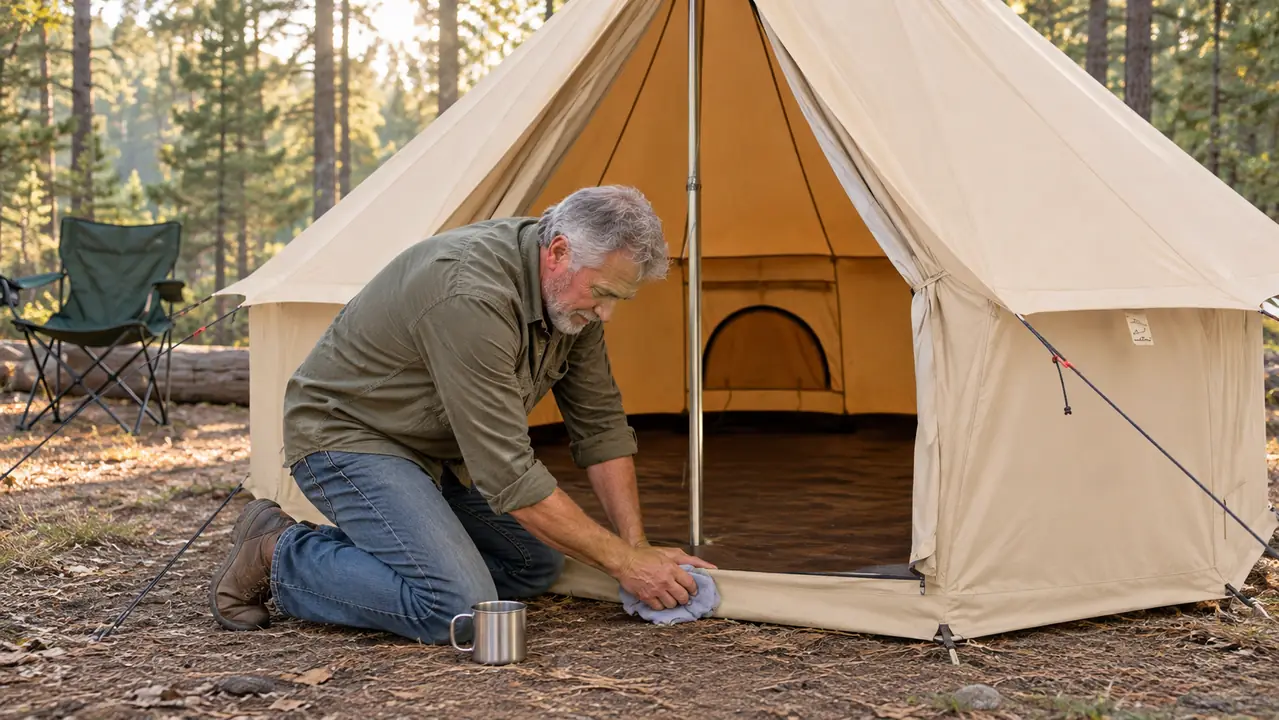
You do not wash canvas the way you wash a jacket. No pressure washer, no detergent, no bleach, no stiff brush. The fabric carries a PFC-free water resistance treatment, and harsh cleaners strip the finish that makes rain bead and roll instead of soaking straight in. Plain water and a soft brush handle most of it. Mild soap, the kind you would use on your hands, is for the spots that need more.
Deal with the specific messes. Pine sap comes off with a little isopropyl alcohol on a rag, then a rinse. Bird droppings come off with cool water and a soft brush before they bake on. Campfire soot, which is the one that gets everybody, needs cool water and patience rather than scrubbing, because scrubbing drives it into the weave. Marshmallow comes off with warm water and a wet cloth, and if the grandkids are along, plan on this one.
Then do the skirt, the fabric flap at the bottom of the walls where it meets the groundsheet. That is where mud, pine needles and lake water collect. Wipe it down and let it dry before you fold. A muddy skirt pressed against dry canvas in a warm truck is the beginning of every smell you have ever blamed on a tent.
Step 3: Dry It Completely Before It Goes in the Truck
This is the step people skip, and it is the one that ends tents. Canvas is absorbent by design. Fold it damp and mildew starts inside a day or two, and once it is in the weave you never really get it out. The smell stays. The fabric weakens along the stained lines. So the rule is absolute: the tent does not go in the truck until it is dry, and damp is not dry.
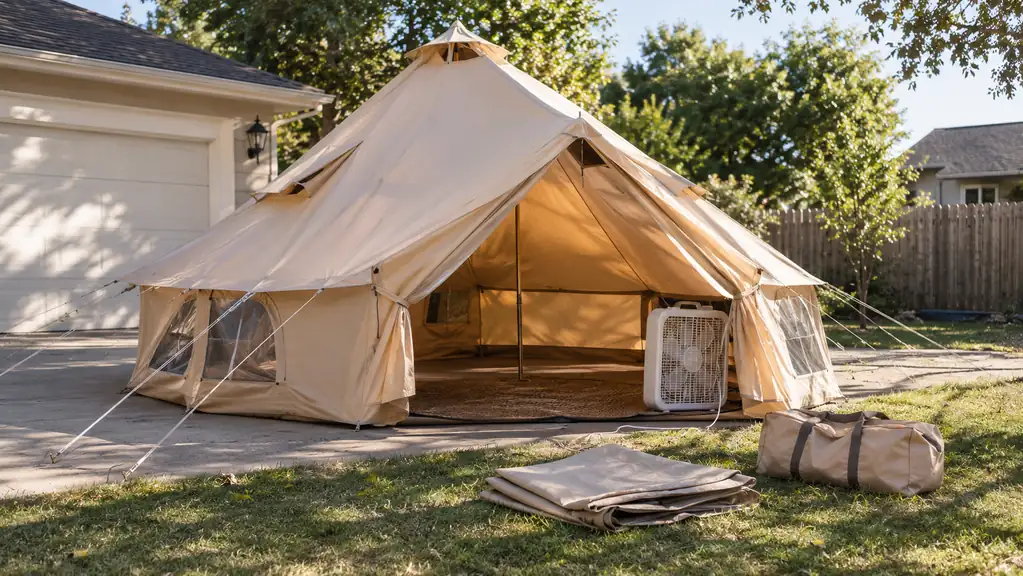
The easy way is to re-pitch it in the yard when you get home and let it stand for a few hours. Doors open, windows open, roof vents open, and the groundsheet lifted at one corner so air moves underneath. If the weather will not cooperate, drape it over two sawhorses in the garage with a box fan pushing air through the middle. Do not lay it flat on the concrete. Concrete holds moisture and wicks it right back in.
Before you fold, run your hands over the seams, the corners and the inner face of the groundsheet. Those are the places that hold water after everything else has dried. The bundle should feel room temperature and dry to the back of your hand. If it feels cool and clammy, it is not done, and another hour in the air costs you nothing next to replacing a tent.
Sixty pounds of canvas never failed me in a storm. It failed in the garage, over one winter, because I folded it damp in September.
Step 4: Baby the Zippers, the Seams, and the Stove Jack
Two doors and three mesh windows mean several zipper tracks, and grit is what kills zippers. Sand in the teeth, pine needles in the coil, and you get a pull that jams halfway with a kid waiting to get out. Carry a small brush, the kind for a camera lens, and run it along the track before every trip. It takes a minute and it adds years.
When a zipper starts to drag, clean it and then lubricate the teeth lightly with zipper wax or a silicone stick. Not cooking spray, which attracts dirt, and not petroleum jelly, which does the same. Work the pull back and forth a few times to spread it. If a pull separates at the bottom, check that both sides are seated before you force anything. Forcing it is how a small fix becomes a new panel.
The stove jack is the part that gets ignored until it matters. When you are not running a stove, that panel stays closed and the flap stays down, because it is a hole in an otherwise water repellent wall. If you do run a stove, keep the roof vents open, never leave a fire unattended, and never pack the tent while the jack is still warm. Ash and creosote work into the canvas, and a burning stove in a closed tent is a carbon monoxide problem before it is anything else.
Step 5: Store It Loose, Dry, and Off the Concrete
Store it loose. The worst thing you can do to canvas is compress it into a tight bundle and leave it that way from October to May. Sharp creases become cracks, and cracks become the places water finds first. Fold it loosely, not along the same lines every year, and keep it in something breathable. A cotton storage bag or a ventilated bin, not a sealed plastic tote that traps whatever moisture is left inside. The WHITEDUCK Regatta ships with a tool kit and poles, and those get stored the same way.
Get it off the floor. Concrete sweats, and a tent sitting on a slab in a Fresno garage in August picks that moisture up. A shelf, a pallet, or two boards across a couple of milk crates all work. Check the bundle once a winter for mice, because canvas is excellent nesting material and a chewed wall panel is not something you patch on the morning of a trip.
Then pitch it once in the off season. Pick a dry day in February, set it up in the yard, let it breathe, look at the seams in good light, and take it back down dry. That half hour tells you whether you have a small repair to do in March or a surprise in June. Ten years of use from a canvas tent is not optimistic. It is normal, when the storage is right.
What Else Helps
A second groundsheet under the tent, sometimes called a footprint, is the cheapest insurance you can buy. The sewn-in groundsheet takes the abrasion from roots, gravel and granite, and a sacrificial layer underneath takes it instead. Cut it slightly smaller than the floor so it does not stick out and collect rain. A plain tarp works. So does a piece of heavy landscape fabric.
Think about where you leave it standing. UV is hard on canvas, and a UV protection claim is not immunity. Leaving the tent pitched in full sun on the same patch of ground from May to September will fade the fabric and cook the groundsheet. If you keep it up at a seasonal site, shift it a few feet every few weeks when you can, and open the vents on hot afternoons.
Set a small routine for the humans too. A doormat outside each door cuts the dirt tracked across the groundsheet by half. Shoes off at the door. The grandkids eat at the camp table, not inside. A lidded bucket for trash keeps raccoons from investigating the mesh windows at night. None of that is about the tent. All of it is about the tent.
Finally, keep the tool kit in the tent bag, not in the truck toolbox. Poles, stakes, tensioners, small spares. When something goes wrong at dusk twenty miles up a dirt road, you want the kit in the bag you are holding, and you want to have looked at it in February when you had daylight and no mosquitoes.
Twenty Minutes at the Campsite, Ten Years of Tent
The WHITEDUCK Regatta Bell Tent is a 6-person, 3 to 4 season canvas tent with 132.67 square feet of floor, a sewn-in groundsheet, a stove jack, roof vents and two doors. Dry it, store it loose, brush the zippers, and it keeps earning its place in the Tacoma.
Amazon Check Today's Price on Amazon →