
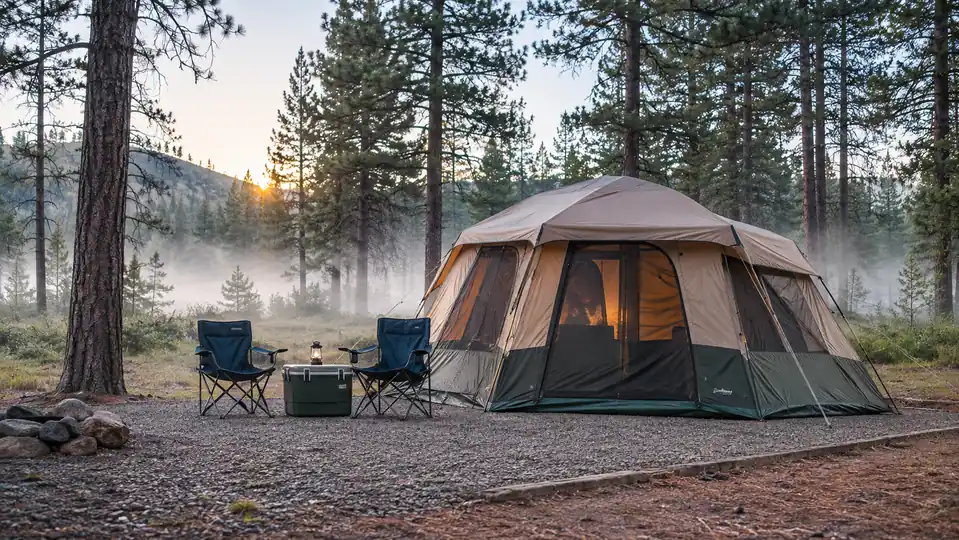
Three summers ago I sold a tent I actually liked because putting it up hurt too much. Six poles, sleeves to thread, a rainfly with a dozen clips, and by the time it stood up my lower back had already decided the trip was over. So when I went looking again, I had exactly one non-negotiable: the tent had to go from the bag to standing without me kneeling on the ground. The CORE Instant Cabin is what I landed on. I have pitched it enough times now, in enough weather, to know where it earns its keep and where it will start to irritate you by the second morning.
Understand what this is before you read further. It is not a first-weekend impression written from a driveway. I have had this tent up in afternoon wind at Huntington Lake, taken it down wet in the rain outside Sequoia, and slept in it with two grandkids who treat the floor like a wrestling mat. I am 61, I camp out of a 2014 Tacoma with a camper shell, and I only care about four things: how long setup takes, whether the inside stays dry, whether the zippers still work after a few seasons, and how much room the whole package eats in the truck. That is the whole lens here.
The Quick Verdict
Genuinely fast to pitch and genuinely dry in steady rain. Heavy in the bag, shallower at the edges than the floor area suggests, and the sleep number on the box is wishful thinking.
Amazon Check Today's Price →The tent I bought because bending over stopped being an option
Pre-attached poles, a cabin layout, and a ceiling tall enough to stand up in. Check today's price and the current size options before your next trip.
Amazon Check Today's Price on Amazon →The Two Minute Setup, Timed With a Stopwatch
Two minutes is the number on the box and it is the number everybody argues about, so let me be precise about what I actually timed. Out of the bag, spread flat, four pre-attached poles folded out and locked into place, shell standing: four minutes and change, alone, on flat ground, the third time I did it. The first time was closer to seven, because I did not trust the poles to lock and fussed at every joint. Add another three to four minutes to stake it out and run the guylines if you want it to survive weather. That is the honest version, and it is still the fastest tent I have owned.
Here is why that matters to me more than the stopwatch does. On the old tent the pole work alone was twelve minutes and most of it happened at knee level or lower. The CORE design has the poles attached to the fabric, so you unfold the whole thing like a large square accordion, then push each corner joint until it clicks and stands. You are upright for almost all of it. My knee does not care how quickly a tent goes up. It cares whether I have to kneel on gravel to make that happen. This design removes that step entirely, and that is the reason I still own the tent.
One warning that never makes it into the listing: the pre-attached poles are the weak point if you force them. Push a joint the wrong way and it will bend instead of click, and a bent pole section is a tent that will not stand square again. Learn which way each hinge wants to fold before you get impatient in the wind. I watched a fellow camper at Shaver Lake fight one for ten minutes because he was pushing against the fold instead of with it. Once he turned it around, it locked in about two seconds. That was a September weekend, the one where the aspens turn and the wind comes up around four in the afternoon like it always does up there. I have since made a habit of setting the tent up once in the driveway each spring before the first trip, just to remind my hands which way the joints fold. Ten minutes in April saves me a bent pole in July, and it costs me nothing but a cup of coffee going cold on the tailgate.
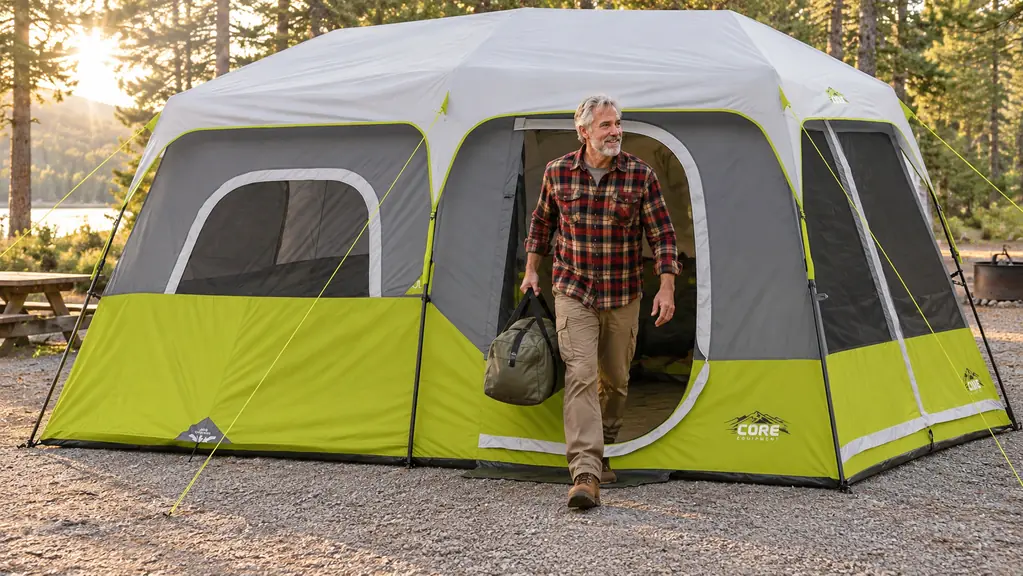
126 Square Feet, a 78 Inch Ceiling, and the Sleep Number Nobody Should Believe
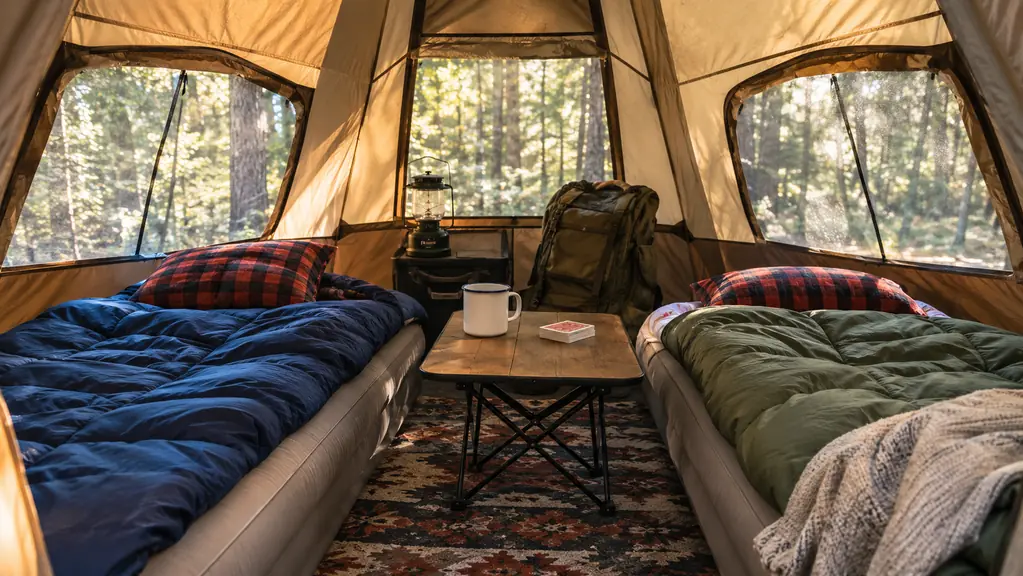
The floor measures 14 feet by 9 feet, which works out to 126 square feet, and the center height is 78 inches. I am a hair over six feet and I can stand up in the middle of this tent to change clothes, which at my age is not a luxury, it is the difference between camping and suffering. Two queen air beds fit side by side with walking room between them. That, right there, is the real capacity of this tent for adults.
The box says it sleeps nine. It will hold nine people the way a pickup truck holds nine people, which is to say everyone is in there and nobody is comfortable. CORE's own material says it comfortably fits four people with gear, and that is the number I would plan around. Four adults with duffels and a cooler makes a good trip. Six adults is a crowd. Nine is a children's sleepover where nobody minds being stepped over on the way to the door. The trip that settled it for me was a July weekend at Huntington Lake with Carol, the two grandkids and another family we camp with. Six of us in the tent, and it worked, but only because the kids took the divider room and every duffel went under a bed. Add two more adults to that same mix and somebody is sleeping against the sloping wall with a cooler for a nightstand.
The multi-room layout is the part I underrated. Being able to hang a divider and put the grandkids on one side with their own door means I am not getting climbed over at six in the morning. Two doors matter more than people expect, as well. One door means everyone in the tent crawls over everyone else for a middle-of-the-night trip outside. With two, whoever is on the far side uses the far door and the rest of the tent stays asleep.
Four minutes from bag to standing, alone, on flat ground. Closer to eight with stakes and guylines. Worth every one of them, because none of it happens on my knees.
Rain, Wind, and What 1200mm Water Resistance Actually Buys You
Water resistance in tent fabric is measured in millimeters of hydrostatic head, which is a plain way of saying how tall a column of water the fabric will hold before it starts to leak. This tent is rated at 1200mm. That is not an expedition number. It is a solid three-season camping number, and here it is paired with a fully taped rainfly and sealed seams, which matter more than the fabric rating on its own. Good fabric with unsealed seams still leaks. A modest fabric with taped seams and a proper fly keeps you dry.
I have tested that twice. The first was a long, steady overnight rain outside Sequoia. Not a storm, just hours of it. Nothing came through the walls or the ceiling. The second was a hard afternoon cell at Huntington Lake with wind behind it, and that one found the single weakness: splash. Rain driven sideways under the edge of the fly will wet the bottom few inches of the wall. The guylines and a properly staked fly fixed it. If you skip the guylines, you have not really pitched this tent, you have only stood it up. That Huntington cell rolled through around two in the afternoon and was gone inside of forty minutes, which is the usual pattern up there. I had staked the fly and run all four guylines that morning out of habit, and I was glad of it. The camper two sites over had his fly clipped on but the lines still coiled in the bag, and he spent the rest of the afternoon mopping the floor out with a towel.
The three-season rating is honest. This is a warm-weather tent. Fully zipped windows and a closed fly hold warmth in on a cold Sierra night better than a mesh-heavy backpacking tent, and they will also hold condensation. On a still night with four people breathing inside, you will find moisture on the inner walls by morning. Vent what you can, leave a window cracked, and keep sleeping bags off the fabric. That is not a defect in the tent. It is how a coated tent behaves when the air does not move.
Taking It Down and Getting It Back in the Bag
There is no fast way to take this tent down. The poles are attached, so you are folding a large amount of fabric around four rigid frames while trying to push the air out, and it never goes back in the bag as small as it came out. I have gotten it to about eight minutes on a dry morning and closer to fifteen in the rain with everything wet and gritty. That is the trade for the quick setup. You save the time going up and you spend some of it coming down.
The bag has a decent opening, which is not a small thing. Plenty of tents ship with a stuff sack sized for a tent that was compressed by machinery at the factory. This one you can get the tent back into without a fight, especially if you fold it flat and roll rather than stuffing. Roll it, do not cram it. Cramming is how pre-attached poles get bent, and a bent pole is the end of your easy setup for good.
If it rains on your last morning, you have a wet tent and a decision to make. Packing it wet once is fine. Packing it wet and leaving it in the truck for a week is how a tent starts to smell and how the coating starts to go. Set it up in the yard when you get home, hose the mud off the floor, and let it dry all the way through before it goes back in the bag. I have skipped that step exactly once and I regretted it. That was a wet Sunday at Shaver Lake the summer before last, when we broke camp early to beat the traffic home and I rolled the whole thing up damp and shoved it under the shell. Four days later the inside smelled like a gym bag left in a hot cab. Two hours in the yard on a hot afternoon and a wipe down with plain water got it back to normal, but I do not plan to test that again.
The Parts That Annoy Me After Three Seasons
It weighs 27.6 pounds. That is fine from the tailgate to the campsite and miserable any farther than that. This is not a walk-in tent if the walk-in is more than a couple hundred yards, and it is absolutely not a backpacking tent. The packed bundle is long, so mine rides in the bed of the Tacoma under the shell rather than in the cab. If your vehicle is small, measure the space before you buy, because this bag does not shrink to fit.
The cabin shape gives you headroom in the middle and a steeply sloping wall at the edges, so the usable floor is smaller than 126 square feet sounds. A cot pushed against a side wall puts your head where the ceiling comes down. Put the tall people in the center and the duffels at the edges. The doors are a reasonable size but not oversized. I manage fine and I am not a small man, but somebody broader across the shoulders will be turning sideways on the way out.
Zippers are the thing I watch, because zippers are what fail first on every tent I have ever owned. Three seasons in, both doors still run clean, with no skipped teeth and no snagging at the corners, and I have not had to wax them. The storage pockets inside are small, but they do the job of keeping a headlamp and my glasses off the floor where I will step on them. Ask me again after five seasons. That is the honest state of it today.
What I Liked
- Pitches upright in about four minutes alone, with no kneeling on the ground
- 78 inch center height lets a six-footer stand up to change clothes
- Taped rainfly and sealed seams kept the inside dry through hours of steady rain
- Two doors and a multi-room layout cut down on middle-of-the-night traffic
- 126 square foot floor takes two queen air beds with walking room between
Where It Falls Short
- 27.6 pounds packed and a long bag, so it lives in the truck bed
- Sleeps nine is a stretch, four with gear is the honest number
- Side walls slope sharply, so the edge floor space is shallower than the middle
- Condensation on still nights if you keep it sealed up tight
- Pre-attached poles bend if you force a joint the wrong direction
Who This Tent Is For
It is for the car camper who is more tired of the setup than of the sleeping. If you have a bad back, bad knees, or you are past the age where crawling around on gravel counts as a reasonable part of a weekend, this design solves the actual problem rather than a marketing problem. It is for families who want the kids in a separate room with their own door. It is for the person who camps three seasons, mostly in fair weather, and gets caught in rain often enough to care about taped seams and a real rainfly.
It is also for the camper who wants to stand up. That 78 inch ceiling changes the whole feel of a wet day. When you are stuck inside for two hours waiting out weather, being able to stand, stretch and move around instead of lying on your back is worth more than any line on a feature list. Carol and I have spent a rainy afternoon in this tent playing cards at a small folding table. That does not happen in a dome tent, and it is the reason this one stays in the truck.
Who Should Skip It
Skip it if you are backpacking, or if your site is more than a short carry from where you park. At 27.6 pounds in a long bag, this is car camping equipment, full stop. Skip it if there are only two of you and you want something you can throw up and tear down in a minute flat, because you would be carrying the weight and bulk of floor space you never use.
Skip it if you camp in real winter, or in exposed country where wind is the main event. Three season and 1200mm is the honest label, and a tall flat-sided cabin catches wind like a sail. This tent has been fine for me in Sierra summer weather, but I would not take it above treeline in October. And skip it if you want a tent you can leave in the truck all season without thinking about it, because any tent with pre-attached poles wants to be dried and stored properly, not jammed back in the bag soaking wet and forgotten until June.
Four minutes of setup instead of forty minutes of your back
The CORE Instant Cabin comes in more than one size, so check the current floor plan and today's price before you decide which one fits your truck and your family.
Amazon See Today's Price on Amazon →