
I have put a tent up in the dark more times than I can count. Shaver Lake, Huntington Lake, a windy night outside Sequoia where the poles on an old dome tent folded up like a lawn chair somebody had sat on. So when a tent tells me it goes up in seconds, my first question is not whether it is fast. My first question is what it does at two in the morning when the wind turns.
The Londtren 4 Person Easy Pop Up Tent and a standard instant cabin tent both make good on the fast setup promise. They just make it in different ways, and that difference decides who should own which. I spent a season trading them back and forth on Sierra trips with my wife Carol, plus a couple of summer runs with the grandkids, and the short version comes before all the detail.
Short answer: if setup time and a stiff lower back are the reasons you started looking at instant tents in the first place, buy the Londtren. If you want to stand up and move around inside your tent like it is a small room, the cabin tent wins that argument and it is not close. Neither one is a bad tent. They are answering two different questions.
| Londtren Pop Up Tent | Instant Cabin Tent | |
|---|---|---|
| Setup | Pops open from a folded disc, poles are pre-attached, no threading. Under a minute by the fifth trip | Frame unfolds leg by leg. Quick for a cabin tent, but you still walk the corners and lock each one |
| Standing height | Low ceiling. You get dressed sitting down or bent over | Tall enough to stand up and put your pants on like a person |
| Usable floor | Sides slope inward, so the outer strip of the 9.2 by 6.6 foot floor becomes gear space | Nearly vertical walls, so most of the footprint is sleeping space |
| Doors | Two mesh doors, front and back, with a vestibule over the front one | Usually one wide door that everybody shares |
| Air on a warm night | Mesh doors front and back pull air straight through the tent | Large mesh panels on the walls do the same job from a different angle |
| Packing it away | Folding it back into the disc takes practice and a certain attitude | Folds like a normal tent, no wrestling match |
| Footprint | 9.2 by 6.6 feet, 60.72 square feet, fits pads a wide cabin tent will not | Wants a bigger and squarer site than a pop up does |
| Steadiness in wind | Lighter frame, so it moves a little in a real gust | More weight and more frame, so it sits steadier once it is staked |
| Best for | Car campers with a bad back who want to be done in a minute | Families planning to spend a rainy afternoon inside |
Where the Londtren Pop Up Tent Wins
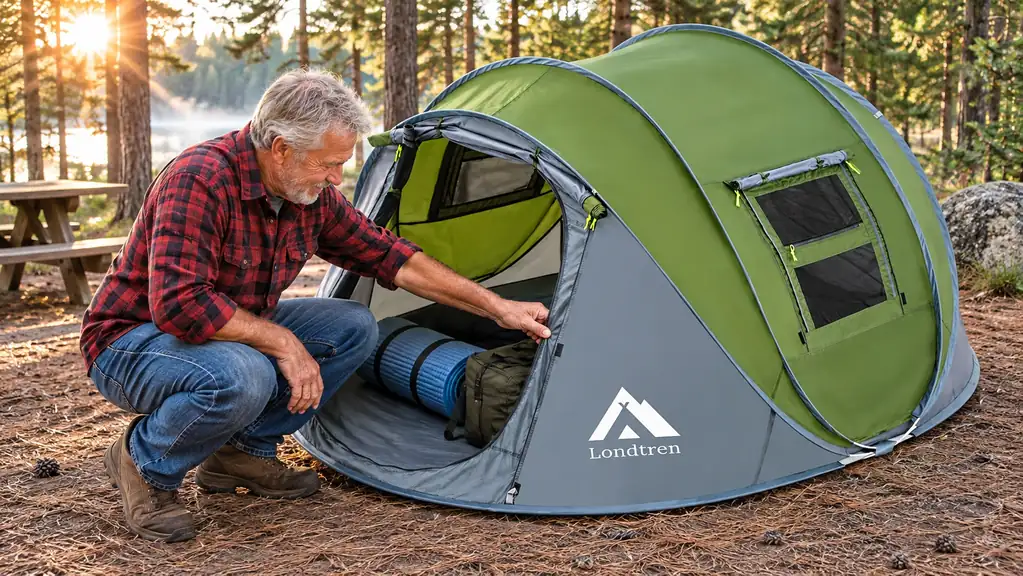
Setup is the whole point of this tent, and it holds up. The poles come pre-attached, so there is nothing to thread and nothing to lose in the grass. You pull it out of the bag, unfold the disc, spread the sides, and it stands up on its own. Push the door frame out, stake the corners, done. The first time took me about two minutes because I was being careful with my back. The fifth time took under a minute, and that was with a headlamp in my teeth.
For anybody with a bad knee or a back that does not like bending, that matters more than any spec sheet on the box. I am 61 and I spent 30 years climbing poles for a living, and kneeling in the dirt to feed a fiberglass pole through a sleeve is the part of camping that punishes me now. The Londtren does not ask for that. You stand, you pull, you stake. There is no stage of the job where you are on your knees in wet grass at ten at night.
The other thing I did not expect to like as much as I do is the second door. Front and back, both mesh, with a vestibule over the front one. Put four people in a tent with one door and somebody is always climbing over somebody else at two in the morning. Two doors splits the traffic, and the vestibule gives you a place to leave muddy boots that is not inside the sleeping area. The mesh front and back also move air straight through the tent, which on a warm Sierra evening is the difference between sleeping and lying there sweating.
The floor is 9.2 by 6.6 feet, which the listing puts at 60.72 square feet, and it is a square shape rather than a long rectangle. That means it drops onto the smaller pads at the older Forest Service campgrounds, the ones a wide cabin tent has to hang off of.
Where the Instant Cabin Tent Wins
Now the part where the cabin tent makes the pop up look silly. You can stand up in it. Not stoop, not crouch, stand. Pulling on pants in the morning without doing a squat is a small dignity I had forgotten I was missing.
Cabin tents also use their floor better. The walls go up nearly straight, so the edge of the floor is actually usable. In a pop up the sides slope inward, which means the outer six inches on either side is where duffel bags live, not where a person sleeps. Take the manufacturer's four person rating seriously and put four adults in either tent, and the cabin tent will feel roomier because all of its floor counts. That is not a knock on the Londtren rating. It is just geometry.
And a rainy afternoon is where the difference really shows. Four people stuck inside a low tent for three hours is a long three hours. In a cabin tent the kids can sit up and play cards on a small table while the weather passes. That is worth something real, and I am not going to pretend otherwise just because I like the pop up.
Skip the pole threading. See today's price on the Londtren.
Pre-attached poles, two mesh doors, a vestibule over the front, and a 9.2 by 6.6 foot floor that fits the small pads. It is the tent I reach for when my back is already complaining before I have left the driveway.
Amazon Check Today's Price on Amazon →How I Tested Both Tents
Both tents went on the same trips, which is the only fair way to compare them. I would pitch one on the pad and the other a few steps away, sleep in one, and move the gear over the next morning. That is a nuisance, but it removes the thing that ruins most tent reviews, which is a man comparing a tent he has used forty times to a tent he set up once in his driveway.
The trips were typical car camping out of the Tacoma, two to three nights, Shaver Lake and Huntington Lake mostly, one run down to the Central Coast where the wind comes off the water and does not stop. Nothing extreme. No snow, no alpine start. The kind of camping most people actually do, which is exactly where most tent advice falls apart.
Setup, In Real Conditions
The pop up is faster on flat ground in daylight. That is not a fair test of anything. The fair test is arriving late, in wind, with the light gone, and a wife who wants to eat dinner.
The Londtren still wins that one, with one caveat. In wind a pop up wants to take off while you are spreading it. Get a stake in the first corner before you do anything else and it behaves. Get careless and you will chase it across the site in front of everybody. The cabin tent does not have that problem because it is heavier and unfolds one leg at a time, but it takes longer, and you are doing it with a headlamp in your teeth while the rain starts.
Two minutes the first time because I was being careful with my back. Under a minute by the fifth trip. The cabin tent never once got below four.
Rain, Wind and the Zippers
The Londtren is listed as waterproof, with 190T polyester walls, a 110G PE groundsheet and 190 mm water resistance, rated four season. What that means in practice is that I rode out two proper Sierra thunderstorms in it and stayed dry, including one night where water was running under the tent. The groundsheet is where cheap tents fail and this one held. The walls did not wick, and nothing came through the seams over my head.
Zippers are the other failure point and these have been fine through a season. Both doors zip on either side of the mesh, they have not caught in the fabric, and the pulls are big enough to find with cold hands. The cabin tent I borrowed has one wide door that zips smoothly too, but a single door takes twice the traffic, and that one was already fraying at the bottom corner by the end of summer.
Wind goes to the cabin tent, and I said so in the table. It has more frame and more weight, so it sits still. The Londtren is a lighter structure and it moves a little in a gust. Not enough to worry me on a normal night, but you will hear it, and if you camp in exposed country you should know that going in.
Living With It for a Weekend
Packing up is where the pop up earns its reputation for being fussy. Folding it back into the disc is a skill. You push the sides in and let the frame fold on itself, and if you fight it, it fights back harder. It took me four tries the first time and I said a few things I would not repeat in front of the grandkids. Once you have the motion it is about thirty seconds. The cabin tent folds like a normal tent, which is to say slowly and without drama.
In the truck, the pop up is the easier of the two to live with. It folds into a flat disc that slides under the camper shell beside the cooler. A cabin tent is a long bundle that eats a corner of the bed. On a short trip with two people that is nothing. On a two week run with four people and all their gear, you will notice it every single time you load up.
The Four Person Question
Both of these are sold as four person tents and neither one is a four adult tent for a week. The Londtren listing is honest about it, saying it fits three to four people in sleeping bags or two to three people with gear. Take the lower number seriously. Two adults and two grandkids is comfortable. Four grown men on a fishing trip will be friendly by morning whether they want to be or not.
The cabin tent has the same rating and more usable floor, so it stretches to four adults a little better. But it has the same problem every instant tent has, which is that the number on the box is a sleeping bag count, not a living space count. Buy one size up from what you think you need and you will be happier in both cases.
Who Should Buy Which
Buy the Londtren if you are the one who sets up camp, if your back or your knees have opinions about kneeling in the dirt, and if your trips run two or three nights in decent summer weather. It is also the better pick on a small pad, since 9.2 by 6.6 feet is a forgiving footprint, and the second door genuinely cuts the nighttime traffic arguments. I have written a longer piece on why this style of tent is easier on a bad back, and a full long term review of this exact tent if you want the season by season version.
Buy a cabin tent instead if you have young kids and you plan to spend real time inside the tent, not just sleep in it. Rainy afternoons, card games, changing clothes without a wrestling match, standing up to get dressed. That is what the extra frame buys you, and it is a fair trade. What I would not do is buy a cabin tent to save your back, because you will still be the one on your knees locking the corner legs.
A minute to pitch, a minute to pack, and no kneeling in the dirt.
Pre-attached poles, two mesh doors, a vestibule over the front, and a 9.2 by 6.6 foot floor. Rated four season, listed waterproof, and it held through a Sierra summer, thunderstorms included.
Amazon Check Today's Price on Amazon →