
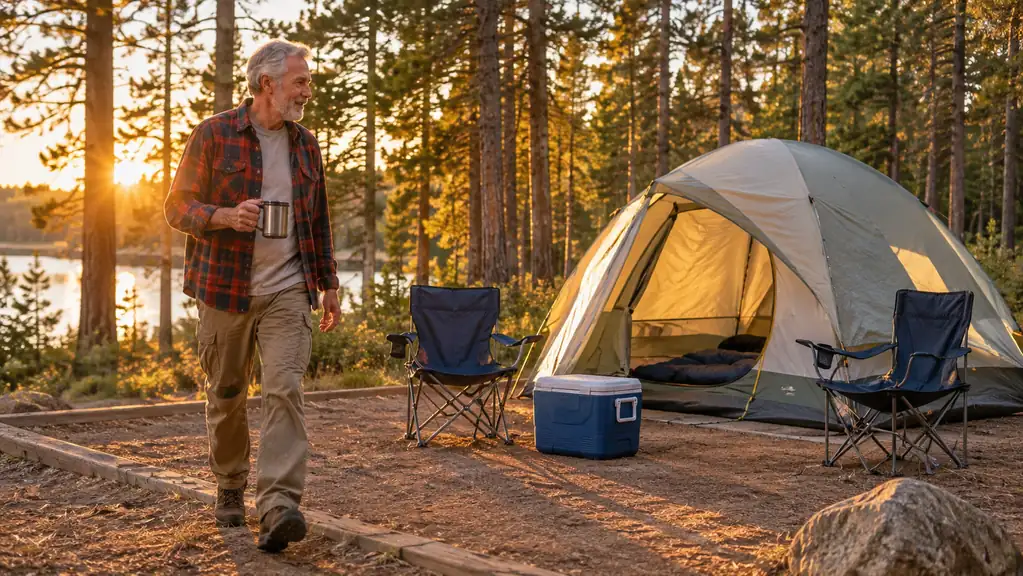
I have pitched the Coleman Sundome in the dark at Huntington Lake with a headlamp clamped in my teeth, in wind coming off Shaver Lake hard enough to keep the rainfly popping all night, and on a Central Coast beach campground where the fog had everything damp by six in the morning. That is twenty-some nights over three seasons in the same tent. It is enough time to know what a shelter does well and where it stops being the right answer. This is what I found.
Some context on who is doing the reviewing, because a tent review is only useful if you know the body and the trips behind it. I am 61 and retired off the utility line. My lower back files a complaint every morning and my right knee has strong opinions about kneeling in gravel. Carol, my wife, comes on most trips. The grandkids come on some of the summer ones. We car camp out of a 2014 Tacoma with a camper shell, mostly Sierra Nevada campgrounds, so weight and packed size matter less to me than setup time, how dry we stay, and whether I can get out of the tent at two in the morning without wrecking my knee.
The Quick Verdict
The tent I keep reaching for on weekend car camping trips. Pitches in about ten minutes, stayed dry through a Sierra thunderstorm, and at 9 pounds one person can handle it alone. It is a three-season shelter, and Coleman calls it water resistant rather than waterproof.
Amazon Check Today's Price →Ten minutes of setup, then you are sitting down
The 3-person Sundome is the size most couples and small families land on. Check today's price and the available sizes before your next trip.
Amazon Check Today's Price on Amazon →How I've Used It
Most of our camping is Sierra Nevada. Shaver Lake and Huntington Lake in June and July, the Sequoia area in late summer, and one or two trips down to a state beach on the Central Coast when the valley heat gets stupid. That is car camping and short walk-in sites, not backcountry. Setup happens out of the truck bed and the tent lives behind the seat for a night or two at a time before it goes back in the garage.
The trips that actually taught me about this tent were the ugly ones. A July afternoon at Huntington where the thunder started before we finished unloading and the rain came in sideways for maybe forty minutes. A night at Shaver with a steady wind that never quite quit and made the fabric talk until dawn. And a foggy beach trip where nothing got rained on but everything got wet anyway. Anyone can review a tent on a bluebird weekend. The tent tells you what it is when the weather turns.
I counted it up before sitting down to write this. Twenty-three nights in the tent across three summers, plus four or five afternoons where I pitched it in the yard just to dry it out after a wet trip and got distracted before taking it down again. The first trip was a June weekend at Shaver in 2023, and the most recent was a September night in the Sequoia area where the temperature fell to about 38 by morning and the tent was part of why I stayed out there instead of driving home to a warm bed.
What I have not done with it is winter camping or any real backpacking distance, so read this as a three-season car camping review. That is exactly what the Sundome was built for, and it is also where most people shopping for a tent like this are headed.
Setup and Teardown: Ten Minutes at 61 Years Old
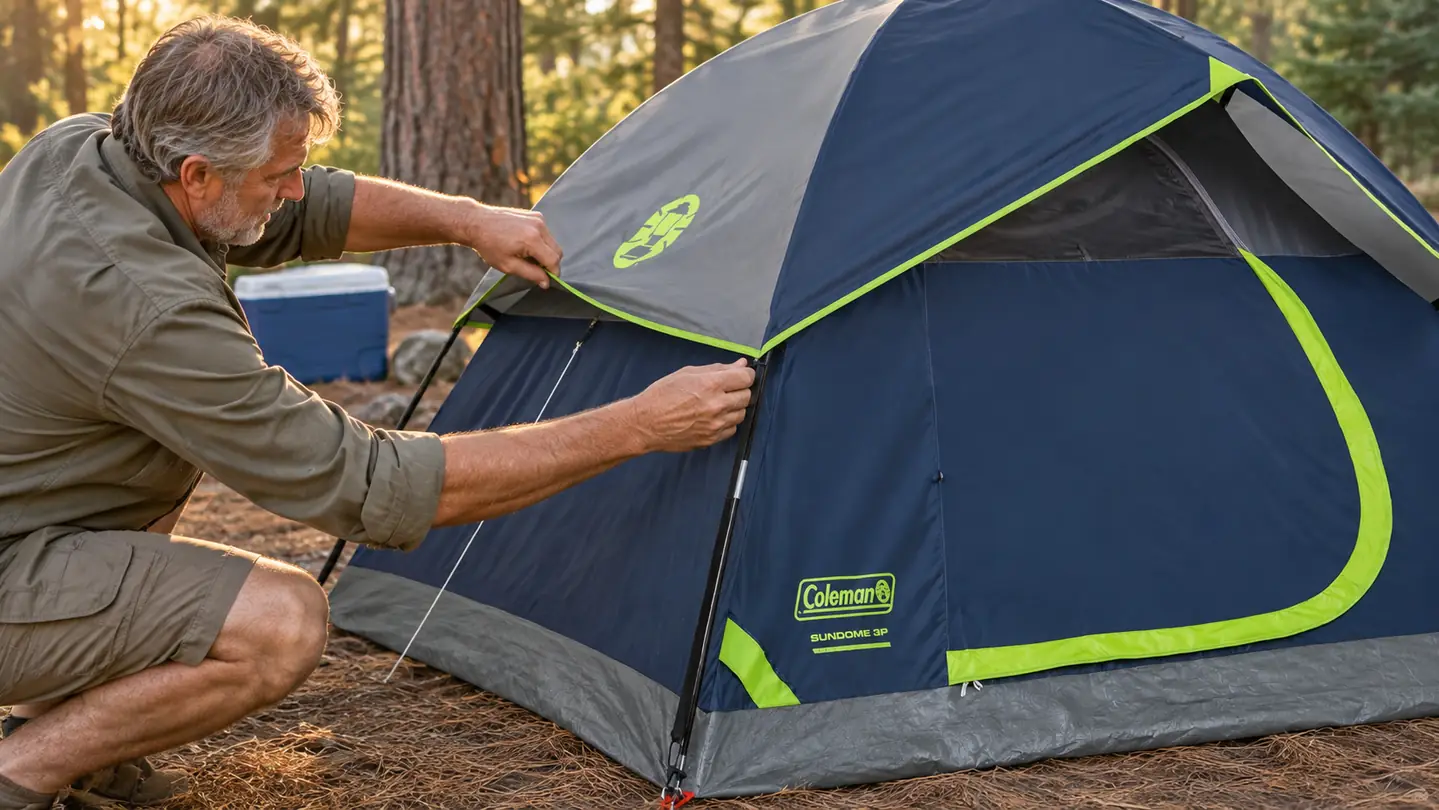
Coleman says ten minutes and I would call that honest, maybe a touch optimistic the first time and about right after that. The poles feed through continuous sleeves that do not snag, which sounds like a small thing until you have fought a tent where the pole hangs up halfway across and you have to shake it through like a stuck garden hose. It is a free standing dome, so you can build it, pick it up, and walk it into position if you set it down badly in the first place.
The first pitch took me longer than ten minutes and I will own that. I had the pole sections laid out in the wrong order, ran one through the sleeve backward, and had to pull it back out and start over while Carol stood there holding the cooler and not saying anything, which is her way. That was a lesson in laying the sections out on the pad in the sequence I need them before I feed anything through. The second pitch and every one since has run in ten minutes or under. On a good evening, with no wind and nobody asking me questions, I have had it standing in seven.
One person can do it, and that matters to me more than the raw minutes. I usually pitch it while Carol deals with the cooler, and I am not bent over for long. The height at the door is the part my back appreciates. There is no crawling in on your belly and no kneeling to work your way around the outside clipping a dozen points. The rainfly goes over the top and buckles down, and once it is on you know it is on.
Teardown is faster than setup, which is the opposite of most tents I have owned. Shake it out, fold it, and it goes back in the bag without a wrestling match. It has never taken me more than one try to get it back in the sack, and I cannot say that about every tent in my garage. When you are packing up in a cold morning with a stiff back, that small mercy counts for a lot.
Weather: Rain, Wind, and What the Rainfly Covers
Here is the honest version of the waterproof question. The Coleman listing calls the Sundome water resistant and, in the specs, says plainly that it is not waterproof. Those are different words and the difference matters. The WeatherTec system plus the included rainfly kept us dry through that sideways forty-minute storm at Huntington, and dry through a long slow drizzle at the beach. What I would not do is trust it for a night of steady heavy rain with the fly pitched sloppy, or for snow. Pitch it tight, keep the fly off the walls, and it does the job it was built for.
The Huntington storm is the one I keep coming back to. It rolled in around four in the afternoon, the sky went from blue to slate in ten minutes flat, and the rain hit at an angle hard enough to push water under the edge of the fly where I had left it hanging loose. That was my mistake, not the tent's. I went out in it, tightened the buckle straps and pulled the fly down and away from the walls, and the inside stayed dry from that point on. Since then I check that the fly is clear of the tent body before I go to bed, every trip, no exceptions.
Wind is where a dome this shape earns its keep. The round profile sheds a gust better than a cabin tent with flat walls to catch it. At Shaver, with the wind steady off the water, the tent moved a little and made noise but never once looked like it wanted to fold up. I peg it out with my own heavier stakes, because Sierra ground is not friendly to light ones, and I take the time to get everything taut instead of half done.
It kept us dry through a sideways forty-minute Sierra thunderstorm. I would not ask it to do that in February.
On a clear night I leave the door zipped down a hand's width for air. Damp mornings happen in any tent if you seal it up tight with two people breathing in it, and the fix is airflow, not a different tent. The Polyguard fabric has held up through three seasons of Sierra sun without going chalky, and the UV protection in the listing is the reason I bother mentioning it at all. Cheap tents turn brittle out here and start cracking at the folds.
Space Inside: 49 Square Feet and a Queen Airbed
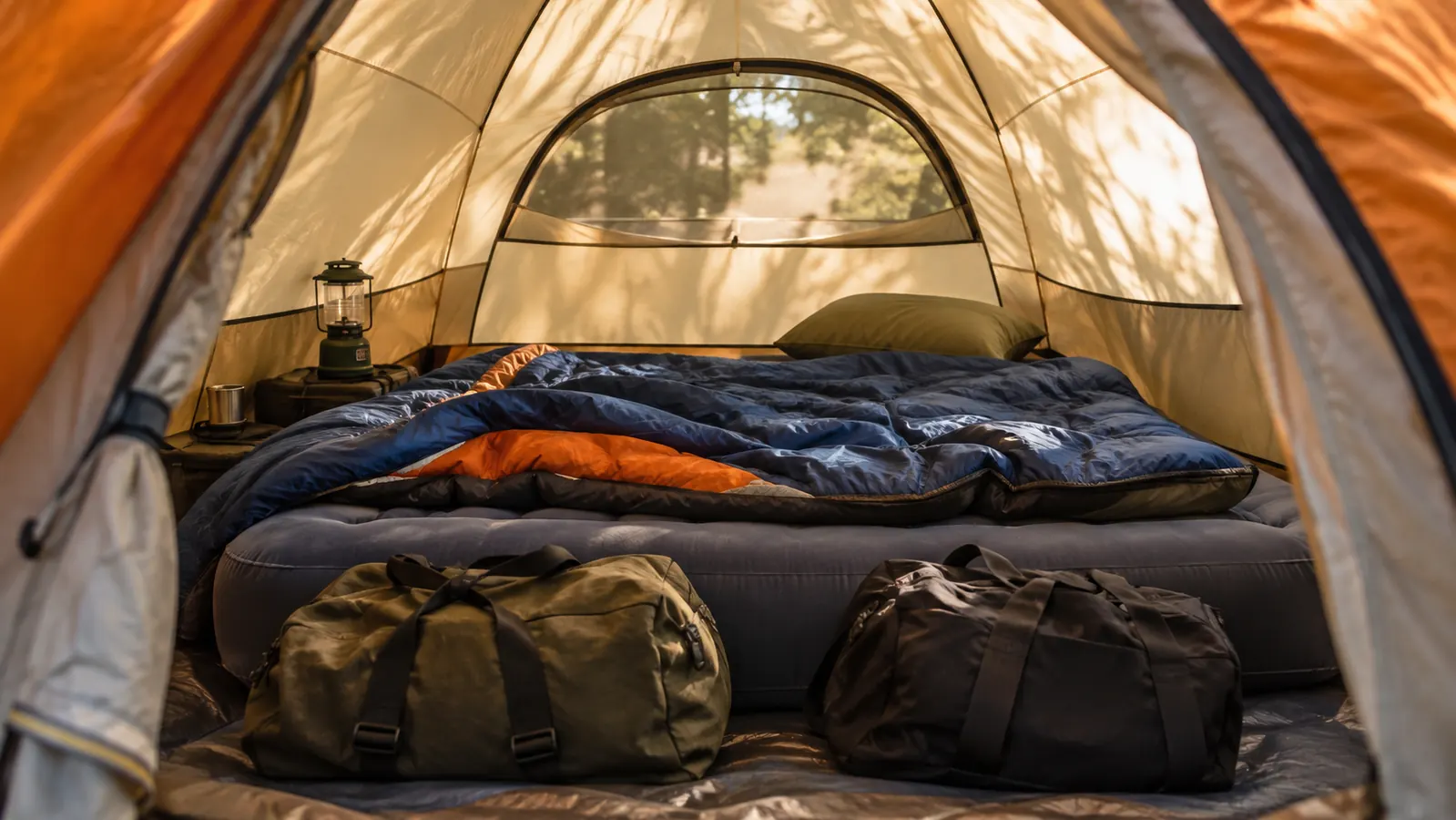
Forty-nine square feet, three person rated, and Coleman says it fits one queen airbed. It does. Carol and I sleep on a queen and there is room to stand a duffel at the head and a bag at the foot. What there is not is much else. This is a sleeping tent, not a hanging out tent. If it rains for a full day and everyone is inside, two adults and a couple of grandkids will be sitting shoulder to shoulder and somebody will be ready to go home.
For two adults it is comfortable, full stop. For three adults it is a squeeze and you will be sleeping head to toe. For a couple plus one kid it works well. The dome shape means the ceiling slopes, so the usable floor is smaller than the number on the box suggests, and that is true of every dome tent, not just this one. I plan for it and pack soft bags instead of hard coolers inside.
One thing worth knowing before you pick a size: those capacity numbers assume sleeping bodies and nothing else. Two adults on a queen airbed with duffels at the foot is about the real capacity of this three person tent. If you have three people who want to be comfortable rather than merely contained, the four person is the smarter buy, and it weighs more and eats more room in the truck bed. That is the honest trade, and I would make it if the grandkids were along more often.
Our gear lives outside or in the truck bed. What comes in is two duffels, a couple of water bottles, a flashlight, and the shoes we do not want in the sleeping bag. At that load the tent feels roomy. Add a camp chair and a card game and it stops feeling roomy fast.
Getting In and Out at Night
This is the section I wish more tent reviews included, because at my age the door is not a detail. The Sundome door is a zippered panel that buckles back out of the way, so it does not drop on your face while you are crawling through in the dark. That sounds like nothing. It is not nothing at two in the morning with a bad knee and no light.
The door opening is low enough that you still duck, and that is the tradeoff on a dome this size. I keep a small lantern just inside the door so I am not patting around on the floor for a zipper pull. My routine is one hand on the door frame, one knee down, and up. It works, and it works better here than in the taller and heavier tent I used to own because there is less fabric to fight through.
The grandkids go in and out of this thing all day when they are along, and the door zipper has taken that beating without skipping a tooth. If you have kids who treat a tent like a playhouse, that is a real test, and this one has passed it so far.
What Wears First, and What I Do About It
Three seasons in, here is what I have seen. The floor is the first thing I would watch. It has held up fine on our trips, but I put a tarp under it every single time and I would not skip that on rough ground. The door zipper is the other wear point. It still runs clean, though I keep the fabric clear of it and I do not yank. Zippers on any tent die from impatience more than from use.
The pole sleeves and the fabric have been the pleasant surprise. No snags, no tears at the sleeves, no stretched seams. Nine pounds of tent gets dragged around a lot between the truck and the pad, and it has taken it without complaint. The rainfly has faded some from sun. That is cosmetic and every fly does it eventually, including the expensive ones.
If something does go, Coleman parts are not hard to find, which is a real reason to buy from a company this size instead of a brand that appears on one listing and vanishes. That availability is worth something on year four, when a pole section or a replacement fly is the difference between a weekend and no weekend.
What I Liked
- Pitches in about ten minutes and one person can manage it
- Stayed dry through a real Sierra thunderstorm with the fly pitched tight
- 9 pounds, and it packs small enough to live behind the truck seat
- Fits a queen airbed with room left for duffels
- Dome shape handles wind better than a cabin tent
- Replacement parts and a full rainfly are easy to come by
Where It Falls Short
- Water resistant, not waterproof. A long heavy rain is a different test
- No standing height, and not much floor left once the airbed is in
- The three person rating is optimistic for three full grown adults
- Fabric fades in strong high altitude sun
- Not a winter tent and not built for backpacking distance
Who This Is For
Families and couples doing weekend car camping, and older campers especially. If your back and knees have started voting on how you spend a Saturday, the setup height and the simple pitch are the whole argument. It is also a good first tent for someone who does not want to learn a complicated shelter in the dark after a long drive. If you are shopping the budget dome category, it is worth reading how the Sundome compares to the Core Dome before you commit, because those two tents split on interior space and on how they behave in wind. And if weather is your main worry, the reasons dome tents hold up in wind and rain are worth ten minutes of your time before you buy anything at all.
Who Should Skip It
Skip it if you camp in the snow, if you are backpacking more than a mile or two in, or if you regularly ride out multi-day rain. Those trips want a true waterproof rating, a bigger vestibule and a tent priced accordingly. Skip it too if you are a family of four who wants to sit inside and play cards through a rainy afternoon. That is a cabin tent job. The Sundome is a shelter you sleep in, and it is very good at that one thing.
The tent is up before the fire is lit
Three seasons, twenty-some nights, still dry. If that is the job you need done, check today's price and pick the size that fits your crew.
Amazon Check Today's Price on Amazon →